Extraordinary secrets about the capitals of the United States

The only state capital without a McDonald's and 11 other fun facts
Image: AmericanBenchCraft

Can you guess which is the only U.S. capital built on top of an extinct volcano? What about which is the oldest state capital, the least populated, or the one with the coldest temperature? If you're dying to know the answers to these questions, read on to discover 12 fun facts about our state capitals that you probably didn't know!

1
Jackson, Mississippi

Image: Engineers' office, department of Tennessee, Public domain, via Wikimedia Commons

Did you know Jackson, Mississippi, is named after the 7th U.S. President, Andrew Jackson? It is one of the four state capitals named after American presidents —the other three are Jefferson City (Missouri), Lincoln (Nebraska), and Madison (Wisconsin).

Jackson is the only U.S. capital built on top of an extinct volcano. Interestingly, during the Civil War, the city was burned by Union troops, giving it the nickname "Chimneyville". In addition, Jackson is best known for being the center of the civil rights movement during the 1950s and 1960s.

2
Santa Fe, New Mexico

Image: Wendy Shervington

In 1610, Spanish settlers established Santa Fe as the capital of New Mexico, making it the oldest state capital in the country. But that's not the only peculiarity of this quaint city with a temperate climate and a unique historical and cultural richness. At 7,000 feet above sea level, Santa Fe is also the highest U.S. capital.

3
Honolulu, Hawaii

Image: Daniel Lee

Known for its spectacular beaches and rich cultural heritage, Honolulu is the only state capital not on the North American mainland. Considered the birthplace of modern surfing, it also has the highest average annual temperature of any U.S. state capital.

But those aren't the only interesting facts about Hawaii's capital. Here are a few equally (or more) crazy ones: it hosts the only royal palace in the United States (Iolani Palace), the island is made up of volcanic soil, and it houses the world's largest open-air shopping mall (Ala Moana Center).

4
Annapolis, Maryland

Image: Terry Granger

Annapolis is a historic city on the shores of the Chesapeake Bay, known for its colonial architecture, nautical tradition, and academic value. But did you know it is also the smallest U.S. capital by land size? Just 6.7 square miles!

Annapolis was also one of the nine capitals the United States has had throughout its history. For nine months during the Revolutionary War, Maryland's current state capital served as the seat of the Confederation Congress.

5
Bismarck, North Dakota

Image: NASA Astronaut, Public domain, via Wikimedia Commons

If you thought Juneau, Alaska, had the lowest average winter temperature of all state capitals, think again! It's actually Bismarck, North Dakota, where the coldest temperature ever recorded was -45°F. Imagine that!

Bismarck was founded in 1872 on the banks of the Missouri River. The city was named after Otto von Bismarck, the chancellor of Germany, to attract German investors. Another fun fact? In 1930, Bismarck and Fargo had a dispute, known as the "Capitol Tower War," over which city should be the state capital.

6
Charleston, West Virginia

Image: Carol M. Highsmith, Public domain, via Wikimedia Commons

Did you know that the original name of West Virginia's capital was Charles Town in honor of the father of Colonel George Clendenin, one of the first settlers?

Charleston is best known for offering a unique combination of history, culture, and outdoor adventure. In fact, the country's first theater, Dock Street Theatre, and the first museum, Charleston Museum, are located in Charleston.

7
Hartford, Connecticut

Image: Balazs Busznyak

Founded in 1635, Connecticut's capital is one of the oldest cities in the U.S. Hartford is known for being a key cultural center in New England. It was the home of writer Mark Twain and is home to historic sites such as the State Capitol, the Harriet Beecher Stowe House, and Bushnell Park, the oldest public park in the country.

Hartford is also called the "insurance capital of the world" due to the presence of major insurance companies. But the city's most curious fact is that it was where Teddy Roosevelt, aboard the Columbia Electric Victoria Phaeton, took the first presidential automobile ride in history!

8
Harrisburg, Pennsylvania

Image: Katherine McAdoo

Pennsylvania's capital city is best known for its role in the Civil War and the Underground Railroad. Located on the banks of the Susquehanna River, Harrisburg has been an important center of transportation and commerce. Today, it is known for its historic architecture, museums, and special events.

Harrisburg is also home to the longest stone arch bridge in the world, the Rockville Bridge, built in 1902. Oh, and in 1979, it came close to a nuclear disaster due to the accident at the Three Mile Island plant, the worst in U.S. history —but that's a longer story for another article!

9
Olympia, Washington

Image: Peter Robbins

Located at the southern tip of Puget Bay, Washington's state capital is known for its natural beauty and vibrant culture. But did you know Olympia is the northernmost state capital in the contiguous U.S.?

Oh, and it's also a great place to try some of the best craft beer in the country!

10
Salt Lake City, Utah
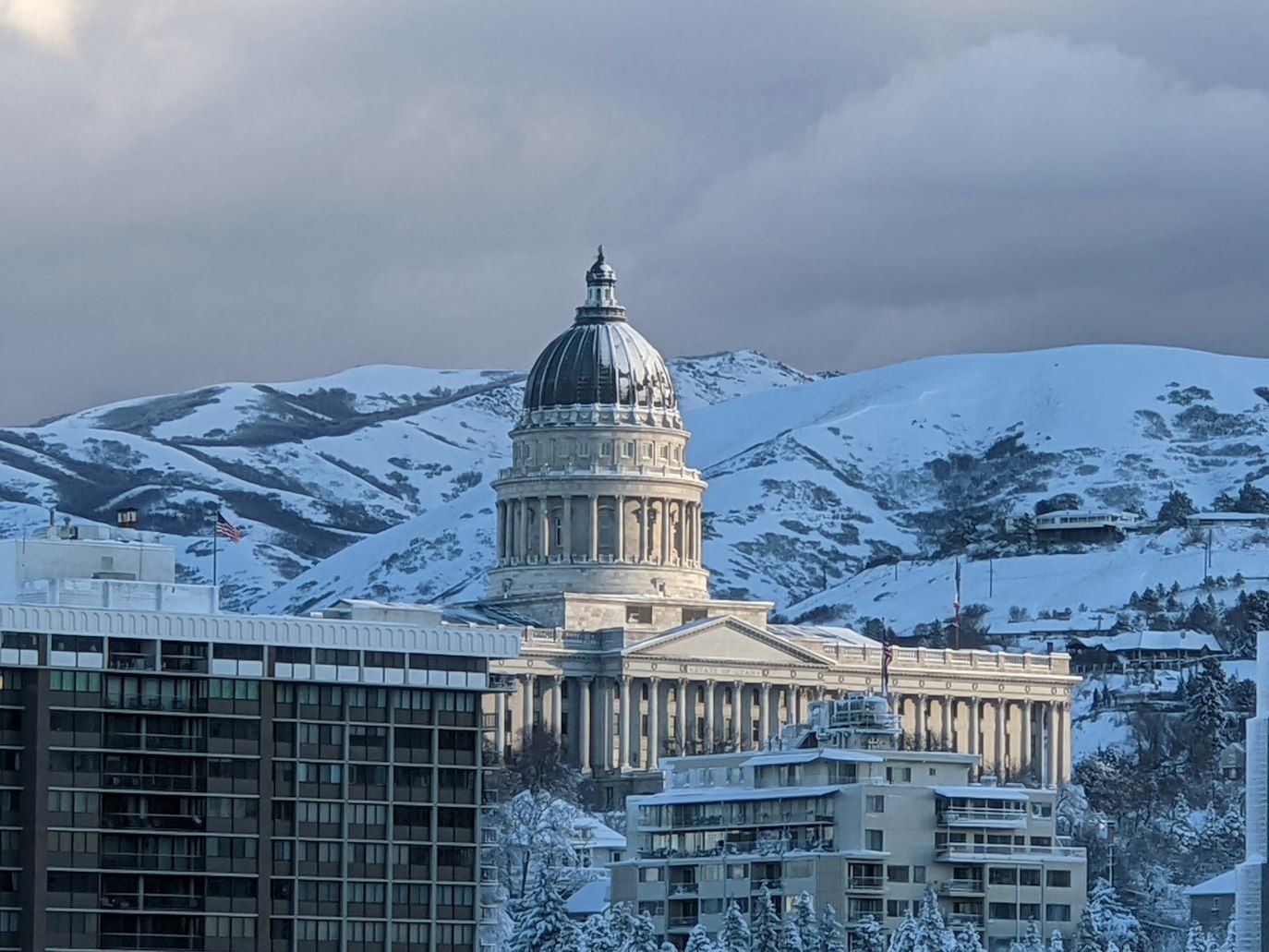
Image: Cong Wang

Utah's state capital is popular for being one of the best places to ski in the United States. But that's not all! Salt Lake City is also the only state capital with three words in its name. Have you ever thought about that?

It has the largest Mormon population in the country and is the world headquarters of the Church of Jesus Christ of Latter-day Saints. Another fun fact? Salt Lake City is home to more plastic surgeons per capita than any other state capital!

11
Montpelier, Vermont

Image: John Holm

Named after the French city of the same name, Montpelier is the least populated state capital, with a population of just 7,900. Probably for that reason, Vermont's capital prides itself on its small local businesses: it is the only state capital that doesn't have a McDonald's or a Starbucks. Could you live without these fast food chains? It doesn't have a Walmart store either!

12
Topeka, Kansas

Image: Nils Huenerfuerst

Topeka, Kansas’s state capital, has several interesting tidbits. For example, did you know its name, of Native American origin, means "a good place to dig potatoes"? Interesting, don’t you think?

In 2010, Topeka temporarily changed its name to "Google, Kansas" to attract the attention of the internet giant and become the capital city of fiber optics. Frivolous facts aside, Topeka was also very important in the history of the civil rights movement.

From fact to fiction

Real-life Americans who inspired iconic fictional characters

Image: Jose Betancourt

Some stories you just can’t make up—like that of a tough archeologist wrestling pythons, a media mogul rising and falling before the eyes of the world, or an eccentric millionaire genius forever scarred from malfunctions of his own inventions. Some unforgettable fictional characters were based on the lives and feats of real people who, willingly or not, found themselves caught in movie-like plots. Read on to explore the lives of 10 Americans who changed the world so significantly that writers decided to immortalize them.

1
Roy Chapman Andrews - Indiana Jones

Image: Intricate Explorer

Roy Chapman Andrews was an American explorer, adventurer, naturalist, and paleontologist who made it out of brawls with pythons, a whale, and armed bandits. He was erroneously reported dead a couple of times and led expeditions across the deserts of China and Mongolia—despite having a fear of snakes . One might safely say that he was the real-life Indiana Jones.

Though neither George Lucas nor Steven Spielberg, the producers behind the franchise, have ever confirmed the claims, they are fully aware of the number of parallels between the movie hero and the former director of the American Museum of Natural History , who collected dinosaur eggs as a hobby. Even Andrews’ granddaughter, Sara Appelbee, believes that Indy was at least inspired by her grandpa.

2
Chuck Wepner - Rocky Balboa

Image: Luisa Frassier

A number of real-life pugilists are said to have inspired Silvester Stalone’s hero —or at least his iconic training methods, such as pulling carts or punching meat packs. Philly boxer Joe Frazier, who even had a cameo in the first movie, was one of them. Also, the nickname "Rocky" was taken from Rocco "Rocky" Francis Marchegiano, an Italian-American heavyweight champion who finished his career undefeated.

But the heart and soul of Rocky was the boxer, Chuck Wepner. Stalone has recounted many times that it was after watching Wepner give his all against the legendary Muhammed Ali that he got the idea for an underdog boxer who would never quit. Wepner’s career and his unyielding spirit later inspired other movies, like Chuck (2016) and The Brawler (2019).

3
Belva Gaertner & Beulah Annan - Velma Kelly & Roxie Hart

Image: tadah

In 1924, reporter Maurine Dallas Watkins covered courthouse stories for the Chicago Tribune . One day, she was asked to write about the trial cases of two women accused of shooting their partners. A few months later, she quit the Chicago Tribune and proceeded to publish a play she had written: Chicago .

The two women were Belva Gaertner and Beulah Annan, both by then acquitted of the charges of murdering their respective partners. The ever-changing accounts of their alibis for the crimes, as well as the audience’s fascination with them, was what inspired Watkins to write the characters of Velma Kelly and Roxie Hart , whose storylines closely resemble those of Gaertner and Annan. Watkins, who had described Gaertner and Annan as the "beauty of the cell block" and the "most stylish of Murderess Row," later sustained that she believed both women were guilty.

4
Draper Daniels & Mary Wells Lawrence - Don Draper & Peggy Olson

Image: S O C I A L . C U T

5

It is known that the multi-award-winning TV show Mad Men focused on showcasing the lifestyle and operations of grand advertising agencies from Madison Avenue, New York, in the mid-20th century. Although parts of the show were exaggerated for dramatic effect, some experts sustain that the anti-hero Don Draper was likely based on Draper Daniels—at least in terms of his career accomplishments.

Daniels was the creative director of the legendary agency Leo Burnett and led famous campaigns for Marlboro, a leading cigarette company in the 1950s. One can only hope that his personal life was less turbulent than that of the fictional character, but the show perfectly transmitted the ingenuity of a big-buck creative director . Did you know that his apprentice, Peggy Olson, was also based on a real-life publicist? It is believed that Mary Wells Lawrence , an advertising legend and pioneering female leader in the industry, inspired the character of Peggy, a hungry and charismatic young writer who is only at the beginning of a brilliant career.

6
William Randolph Hearst - Charles Foster Kane

Image: Zoe

Citizen Kane (1941), widely considered one of the best films ever made, was famously inspired by the life of media mogul William Randolph Hearst. Charles Foster Kane, just like his real-life counterpart, rose from humble beginnings to immense wealth by building a newspaper empire . In this case, the history of personal scandal depicted in the movie did match reality.

Like Kane, Hearst had a mansion complete with private zoos and priceless art collections. Both men had political careers and a heavy presence in the press and media. Hearst did not take the movie lightly; the portrayal was so thinly veiled that the story offended him greatly, particularly the inclusion of a doomed romance that paralleled his relationship with actress Marion Davies.

7
Pocahontas

Image: EricThriller

We know that Disney's Pocahontas (1995) is a highly romanticized version of historical accounts, but Pocahontas indeed was a real-life Native American woman in the 1600s. The movie took great liberties with facts. For example, Pocahontas was only 10 or 11 years old when she met English newcomers, not the young woman suggested in the film.

She was indeed the daughter of Powhatan , their tribe chief, and early accounts claim that she intervened to prevent the execution of English sailor John Smith, though these tales have been disputed over the centuries. The story of her life, captivity, transformation to Christianism and marriage to John Rolfe have been represented in several films, plays, books, and paintings throughout time, even though historical records of her life are scarce.

8
Howard Hughes - Tony Stark

Image: Igor Bumba

Sure, perhaps Iron Man never existed. But Tony Stark might have, in a way. The billionaire genius who became Marvel's icon was heavily inspired by real-life American industrialist and aviator Howard Hughes. Both Stark and Hughes were visionary inventors, known for their technological prowess, complex personal lives, and eccentric personalities.

During his lifetime, Hughes was one of the richest and most influential people in the world, and, like Tony Stark, he behaved accordingly. Hughes had romantic entanglements with Hollywood stars and led a luxurious lifestyle. This was parodied in Stark’s playboy personality and his interactions with the press. Interestingly, Hughes, an enthusiastic pilot, carried several injuries he had sustained from being in four different plane crashes. These wounds were paralleled by those in Stark, who carried a literal gap in his body after an accident caused by a malfunction of his own technology.

9
Peggy Lee - Miss Piggy

Image: cottonbro studio

Yes, even Miss Piggy drew inspiration from a real person. That person was none other than Peggy Lee, the legendary jazz singer , songwriter, and actress with a 70-year-long career. Lee was known for her sultry voice and sassy but commanding stage presence, a diva superstar personality. Does that remind you of a certain Muppet?

Miss Piggy’s signature traits include her charm and her conviction that she is destined for stardom . Many of Peggy Lee's qualities, even physical traits like her blond hair, were gracefully taken in by Miss Piggy’s creators, but not all. For instance, the tendency to karate-chop Kermit the Frog when she is mad at him might have been ad-libbed.

10
The Unsinkable Molly Brown

Image: Jean-Christophe André

Molly Brown survived the sinking of the RMS Titanic, and her persona even made it to the 1997 James Cameron film. In it, Kathy Bates played Margaret Brown, aka "The Unsinkable" Molly Brown. A socialite, activist, and philanthropist, she showed stellar leadership and bravery during the disaster as a first-class passenger who helped several people into lifeboats before being forced to board one herself.

In the movie, she is portrayed as a strong, outspoken woman ready to defy social conventions and eager to make space for more people in the lifeboats. Reportedly, that night in 1912, she insisted that the boat return to save others, but her pleas were ignored. Real-life Molly Brown was known for her flamboyant personality ; she spoke several languages and traveled extensively. She even tried her hand at acting.

11
Buzz Aldrin - Buzz Lightyear

Image: Kindel Media

Finally, it must be said: Buzz Lightyear was named and designed in honor of none other than Buzz Aldrin, the second person to walk on the Moon . Of course, as one of the faces and emblems of space exploration, Aldrin served as a direct inspiration for the beloved space ranger from the Toy Story franchise.

Sure, Buzz Lightyear was just a toy, but the yearning in his eyes when he looked at the stars was powerful enough to represent any astronaut. Was Aldrin honored by this nod to him? Yes, he even participated in several Disney events where both Buzzes discussed space travel, and the real astronaut gave the character advice about venturing "to infinity and beyond."

Outlaws & Cowboys

Saddle up: Here are 10 of the most iconic figures of the American West

Image: Zeynep Sude Emek

American Wild West stories are fascinating but would be incredibly boring without the men and women who roamed the untamed frontier in search of new opportunities. Their activities ranged from lawmen and gunslingers to ranchers, gamblers, farmers, rodeo stars, bounty hunters, and outlaws. Join us to learn about the lives of 10 cowboys (and cowgirls!) who helped shape our nation’s cultural landscape.

1
"Buffalo Bill" Cody

Image: Illinois State University, Public domain, via Wikimedia Commons

If we had to name the most famous cowboy in history , Buffalo Bill Cody would probably be a top contender. Throughout his lifetime, Cody greatly contributed to shaping the image we have of the American West.

Born in Iowa in 1846, he earned his nickname while working for the Union Pacific Railway, where railroad workers were amazed by his hunting skills. But history had bigger plans in store for Cody, and he would soon become an actor , traveling throughout the eastern United States performing plays based on stories of the Wild West for more than 30 years.

Eventually, poor business management and a certain change in popular interests led Buffalo Bill to ruin and he retired from show business just two months before his death in 1917. He was, however, mourned by millions of people who considered him a hero.

2
John Henry "Doc" Holliday

Image: Mehmet Turgut Kirkgoz

John Henry "Doc" Holliday was born in 1851 in Griffin, Georgia, into a wealthy family. He earned his Doctor of Dental Surgery degree in Philadelphia but was shortly thereafter diagnosed with tuberculosis and advised to live in the drier, hotter climate of the West.

In Dallas, Texas, he pursued his trade as a dentist but also discovered saloons and whiskey. Soon, realizing that gambling could be much more lucrative than dentistry, he began his professional gambling career.

The rest of his life was spent among crooks, gunfights, and jailmates in New Mexico, Arizona, and California. At only 36 years old, his lungs could not keep up with his gunslinging way of life and he finally met his death in 1887 in a hotel bed in Colorado. It is said that his last words were, "This is funny."

3
Butch Cassidy and The Sundance Kid

Image: yavuz pancareken

The lives of Butch Cassidy and The Sundance Kid became legendary pretty quickly. As early as 1903, their exploits inspired the first modern film —Edwin S. Porter's _The Great Train Robbery_— and since then, their adventures have not ceased to be portrayed by popular culture. In a way, they symbolize the definitive end of the romanticized Western era at the hands of 20th-century industrialization and urbanization.

Both cowboys were members of a gang known as "The Wild Bunch," which earned them a reputation as bank and train robbers. According to lore, after several years of crime and run-ins with the law, the bandits managed to escape to Latin America. Eventually, they were caught and killed in Bolivia in 1908. The fact that their graves were never found helped fuel the myth that they had, in fact, returned to the United States and lived in anonymity for many more years.

4
Jesse James

Image: Steve

Jesse James's life is one of the most emblematic of the Wild West. His criminal career began after his involvement with pro-Confederate guerrillas during the Civil War. Along with the Younger brothers, he created a gang with which they robbed banks, trains, stagecoaches, and stores from Iowa to Texas and from Tennessee to California.

It is believed that throughout the years they netted more than a quarter of a million dollars. Despite the gory nature of their heists and murders, the gang often had public sympathy.

Jesse's death is as controversial as his life. At only 34 years old, he was shot in the back by one of his gang partners, who hoped to obtain a state reward in exchange for his betrayal. The public was not happy with the government conspiring to assassinate a citizen, no matter how criminal, and the matter became a scandal, resulting in Jesse James's rise to mythical status.

5
Annie Oakley

Image: International Film Service, Public domain, via Wikimedia Commons

From an early age, Phoebe Anne Oakley Moses, better known as Annie Oakley, took up hunting to help support her family. At the age of fifteen, she won a competition against the famous marksman Frank Butler, to whom she later married. Together, they appeared in several exhibitions across the country and, in 1885, joined Buffalo Bill's Wild West show.

Annie was able to open the edge of a letter, shatter glass balls thrown in the air, and hit dimes held between her husband's fingers or apples placed in her poodle's mouth by shooting from 30 paces away. Her life was so rich and fascinating that she was the inspiration for several movies and plays.

6
Billy the Kid

Image: See page for author, Public domain, via Wikimedia Commons

According to legend, Henry McCarty, better known as Billy the Kid, killed at least 21 people during his career as a notorious outlaw in New Mexico. However, he cemented his place in the pantheon of frontier legends not so much for his murders as for his personality and incredible marksmanship skills.

Born in the late 1850s in the Irish slums of New York City, McCarty had to reinvent himself as a gunslinger after the death of his mother when he was just a teenager. His life and the events surrounding his death at the hands of legendary lawman Pat Garrett were immortalized in numerous films, books, and songs. In fact, Billy the Kid holds the record as the most portrayed individual in cinematic history.

7
Lucille Mulhall

Image: Melissa Walsh

By 1900, split riding skirts allowed women to compete in rodeos without shocking Victorian-era audiences. But the truth is that women have been participating in exhibitions even in the early days of the Old West.

Lucille Mulhall is considered America's first legendary cowgirl. Born in 1885, Lucille grew up on her family's ranch in Oklahoma, where she acquired her incredible cattle-roping skills. She began performing in shows as a teenager and, throughout her career, competed in many rodeos, setting a few roping world records.

8
Belle Starr

Image: Pixabay

Perhaps the most famous female gunslinger in the history of the West was Myra Maybelle Shirley Reed Starr, better known as Belle Starr. Born in Missouri in 1848, Belle had a fairly well-to-do childhood and was a bright student. However, when her family moved to Texas after the Civil War, the young girl stumbled upon the James-Younger gang. After falling in love with Cole Younger, she became a member of the gang.

That love affair didn't last long, but a few others followed, which led her to live outside the law for the rest of her life. Her alleged riding and gun skills increased her fame throughout the country, turning her into a legend.

9
Wyatt Earp

Image: National Archives at College Park, Public domain, via Wikimedia Commons

Wyatt Earp belonged to a large family whose members were famous for being gunfighters, gamblers, bison hunters, miners, and lawmen. While all were notorious Wild West characters, it was Wyatt's exploits that have gone down in history. His life is testimony to the ambiguity that prevailed at a time when there was no distinction between upholding the law and transgressing it.

After a long life traveling the American West as a deputy sheriff, bounty hunter, and saloon owner, in 1905 Wyatt settled permanently in Los Angeles, California. He became a film consultant in Hollywood, befriending producers, directors, and actors. It is even said that John Wayne took Earp’s stories as inspiration for some of the tough characters he portrayed on the big screen.

10
"Wild Bill" Hickok

Image: Turuncu Sakal

James Butler Hickok, better known as "Wild Bill," is a legendary folk hero thanks to the many stories that romanticized his life as a soldier, gunslinger, gambler, marshal, and actor. Over the years, his adventures have been retold numerous times in pop culture. The truth is that Hickok did more in his thirty-nine years of life than most who lived twice as long.

Since his birth in Illinois in 1837, he is said to have been involved in some of the most dramatic and, at the same time, most spectacular events in the history of the Wild West. His death, unsurprisingly, is also legendary. In 1876, while playing a game of poker in a saloon in Deadwood, Dakota Territory, a man named Jack McCall shot him in the back of the head. The cards he was holding at the time —two pairs of Aces and black Eights— became the well-known "dead man's hand."

Explore more American facts

Choose your favorite category!

General
General

As American as apple pie—the very best America has to offer!

Culture
Culture

Delve into the astounding richness of American lore.

Geography
Geography

Hop in and explore vast and diverse American landscapes.

History
History

Discover the key moments that shaped the United States.