General General 4 min read

Quirky patriotism

Uncle Sam's funhouse: America’s oddest facts
Image: RDNE Stock project

America’s a big place, and let’s face it, a little quirky too. For example, did you know that squirrels have a special bridge to cross the street in one state? And that’s not all: from bourbon barrels to squirrel bridges, our country is full of surprises hiding in plain sight. Grab your reading glasses and settle in for a fun ride through some of the weirdest tidbits about the US that you’ve probably never heard before.

1
Kentucky's got more bourbon than people

Image: javier kober

If Kentucky’s barrels of bourbon had voting rights, they’d outnumber the citizens by over two million. Yep, the state has around 5 million people, but more than 7 million barrels. That’s over one barrel per person! Bourbon is big business down there, and the aging process means those barrels are just hanging out, soaking up the Kentucky air. Cheers to that!

2
Lake Superior could soak two continents

Image: Riley Crawford

Try this on for size: Lake Superior holds so much water that it could cover all of North and South America with a foot of water, that’s more than three quadrillion gallons. It’s not just "superior": it’s the largest freshwater lake by surface area in the world! No wonder it looks like an ocean when you stand on the shore.

3
New York City beats 40 states in population

Image: Thomas Habr

Think your state is crowded? New York City alone has more people than 40 of the 50 US states. That’s over 8 million people packed into five boroughs; more than the entire population of states like Nebraska, Idaho, or even Kentucky. It’s one bustling, never-sleeps kind of place, right?

4
Oregon talks the fastest, Mississippi takes it slow

Image: Marek Studzinski

According to a speech analysis study, Oregonians zip through their words quicker than anyone else in the country. On the other hand, people in Mississippi take their sweet time, probably because there's no need to rush when you’ve got good company and a rocking chair.

5
Washington squirrels have their own skywalks

Image: Ilnur Kalimullin

In Longview, Washington, squirrels cross the street using adorable little bridges built specially for them. Locals kept seeing critters get flattened, so they constructed a series of rope walkways in the trees. Now, that’s a whole network called the " Nutty Narrows ." Proof that even squirrels get special treatment in small-town America.

6
You can legally hunt unicorns in Michigan
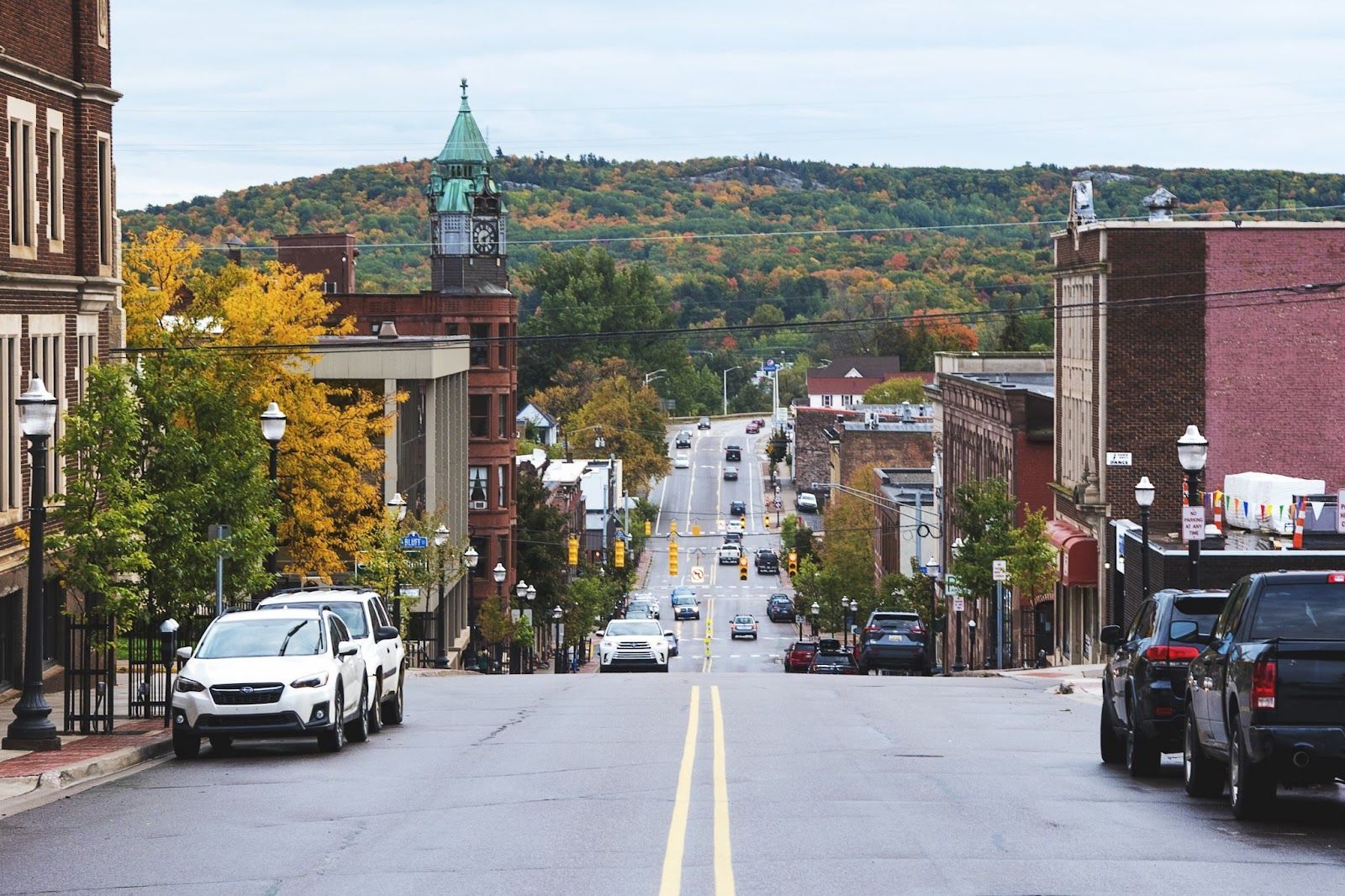
Image: Gary Meulemans

Well… sort of. Lake Superior State University in Michigan offers a whimsical "Unicorn Hunting License" as part of a long-running campus tradition. It’s all in good fun, of course, but the license is real; you can request one. Just don’t expect to catch anything other than smiles.

7
Las Vegas hotels could host you for four centuries

Image: David Lusvardi

If you stayed one night in every hotel room in Las Vegas, it would take you over 400 years to get through them all. That’s around 150,000 rooms, more than any city in the world. Sin City isn’t just flashy; it’s enormous. You could retire three times over before seeing them all.

8

9
Michigan's lavender maze is visible from space

Image: Léonard Cotte

In western Michigan, there’s a sprawling lavender labyrinth so big that it can be seen on Google Earth. Grown by Cherry Point Farm & Market, this fragrant puzzle isn’t just beautiful, it’s relaxing too. Imagine strolling through acres of blooming purple under a summer sky. Have you added it to your bucket list yet?

10
The Hoover Dam’s concrete could pave the nation

Image: Gerda

Here’s a mind-boggling fact: engineers poured enough concrete into the Hoover Dam to build a two-lane highway from San Francisco to New York. How much is that? That’s 4.4 million cubic yards, give or take. It’s a concrete colossus. And it's still standing strong after nearly a century.

11
Boston drivers are the worst, Kansas City’s the best

Image: todd kent

According to insurance data, Boston has more fender-benders and claims than any other large city. Drivers there can be a bit... spirited. Meanwhile, Kansas City drivers, apparently, are so courteous and careful, they top the charts for safety. Beep beep!

12
Kansas could feed the world at least once

Image: Samuel Myles

Each year, Kansas produces enough wheat to bake a whole lot of bread—enough to feed everyone on Earth for about two weeks. That’s nearly 300 million bushels annually. No wonder it’s called the Breadbasket of America. If bread ever becomes currency, Kansas would be rich.

13
Crater Lake is Statue-of-Liberty deep

Image: Jeff Hopper

Oregon’s Crater Lake is no shallow pond—it’s the deepest lake in the US, plunging down 1,943 feet. That’s enough depth to stack six Statues of Liberty, one on top of the other, with room to spare. Yes, you read that right! Formed in the crater of an ancient volcano, it’s as dramatic as it is stunning.

14
Atlanta is peachy... maybe a little too peachy

Image: Ronny Sison

If you’re driving through Atlanta and see Peachtree Street, don’t assume you’re close to your destination because there are over 70 roads with some form of "Peachtree" in the name. Peachtrees, Peachtree Circle, Peachtree Battle… It's a maze of fruity confusion. Now you know, so bring a map!

Geography Geography 3 min read

Only in America

Born in Accident, raised in Looneyville—the wildest U.S. town names

Image: Lachlan Donald

From puns to head-scratchers, some U.S. towns have names that sound like jokes—but they’re very real! Behind many of them lie strange stories, old legends, or just one stubborn settler with a sense of humor. From Accident to Booger Hole, and even straight-up Hell, these oddly named places tell stories of America’s diverse and often eccentric past. Here’s a coast-to-coast look at 10 towns that’ll make you do a double take.

1
Truth or Consequences, New Mexico

Image: Lachlan Donald

Originally named Hot Springs, the town changed its name in 1950 after a popular radio show. Host Ralph Edwards had promised to broadcast from the first town that renamed itself after the program.

The publicity stunt worked—Edwards visited annually for the next 50 years. Despite its playful name, Truth or Consequences is a legitimate spa town, known for natural hot springs and health resorts.

2
Accident, Maryland

Image: David Trinks

Surveyors in the 1700s accidentally claimed the same plot of land twice, giving rise to the town’s odd name. The mistake was eventually resolved, but the name stuck.

Today, Accident is a quiet town in Garrett County with fewer than 400 residents. It occasionally draws attention from curious travelers and lovers of unique place names.

3
Boring, Oregon

Image: everett mcintire

Named after William H. Boring, a Civil War veteran who settled in the area. Locals embraced the name, even forming a tongue-in-cheek partnership with Dull, Scotland, and later Bland, Australia, to form the so-called "Trinity of Tedium"—all in good fun!

Boring capitalizes on the irony with signs that read, "The most exciting place to live." It’s a quiet suburb of Portland with a strong farming history.

4
Chicken, Alaska

Image: Yiyi Yang

Miners wanted to name it after the ptarmigan, a local bird, but couldn’t agree on the spelling , so they went with "Chicken" instead.

Located near the Canadian border, Chicken has no phone service and a population of fewer than 20. It remains a favorite roadside stop along the Taylor Highway.

5
Booger Hole, West Virginia

Image: Sharosh Rajasekher

Named after ghost stories and tales of mysterious disappearances in the early 1900s. "Booger" was slang for ghost or boogeyman.

The area gained notoriety for several unsolved crimes, adding to its spooky reputation. Today, it’s mostly a rural area with a curious past and no official signage.

6
Monkey’s Eyebrow, Kentucky

Image: Roger Starnes Sr

One origin story claims the name came from the area’s appearance on a map —it looked like the eyebrow on a monkey’s face.

Located in Ballard County, this unincorporated community doesn’t offer much beyond a memorable name. It’s a quiet farming region in western Kentucky.

7
Hell, Michigan

Image: Brad Switzer

Allegedly, this name came from a German traveler’s comment, "So schön hell!" meaning "so beautifully bright." In a humorous twist, however, locals took the "hell" part literally.

Today, tourism thrives on the name, with themed businesses like the Hell Hole Diner and even a wedding chapel. You can even buy a square inch of "Hell" online.

8
No Name, Colorado

Image: Holly Mandarich

When building a highway exit, engineers labeled the spot "No Name" as a placeholder. Locals voted to keep it that way.

Located near Glenwood Springs, it’s known for No Name Creek and the No Name Tunnel. It remains a photo favorite along I-70.

9
Toad Suck, Arkansas

Image: Claud Richmond

Likely comes from riverboat crews who drank at the local tavern until they "swelled up like toads." The "suck" refers to a river eddy—a swirling current in the water.

Today, the town is best known for the annual Toad Suck Daze festival, which celebrates the odd name with music, food, and toad races.

10
Satan's Kingdom, Massachusetts

Image: Jeffrey Clayton

Located near Northfield, this ominously named unincorporated village borders the Connecticut River. Despite its fiery name, it’s a mostly quiet rural area.

Legend says the name came after a churchgoer left a sermon about hellfire and saw a forest fire raging across the river —declaring that "Satan’s Kingdom was burning." A similarly named area exists in Vermont as well.

11
Why, Arizona

Image: Laura Mann

Named for the Y-shaped intersection of State Routes 85 and 86, the town had to adopt a name with at least three letters due to Arizona law, so "Y" became "Why."

Why lies near the Organ Pipe Cactus National Monument and remains a popular pit stop for desert road trippers.

12
Looneyville, Texas

Image: Vivian Arcidiacono

Named after store owner John Looney in the 1800s, Looneyville is not a joke—just an old Texas family name.

Looneyville is in Rusk County, deep in East Texas. It remains unincorporated but shows up on maps and road signs.

Culture Culture 6 min read

How do the most powerful blow off steam?

Which US President spent a quarter of his presidency at a ranch in Texas?

Image: Robert LeRoy Knudsen, Public domain, via Wikimedia Commons

Running the White House is a highly demanding job, so throughout history, many presidents have found ways to relieve the pressure and stress of leading at the highest level of government. When not shaping the path of the nation, presidents have enjoyed a variety of hobbies and pastimes that provide them with leisure time to relax, unwind, and clear their minds. From golfing and swimming to reading and painting, here are 12 U.S. Presidents who found the perfect balance between pleasure and duty.

1
George Washington

Image: Alonzo Chappel, CC0, via Wikimedia Commons

Founding Father and first president of the United States, George Washington, enjoyed many recreational activities during his free time. He was a true outdoorsman—he loved hunting and fishing and was a devoted gardener and farmer .

It’s common knowledge that after deciding not to run for a third term, he retired to his Virginia farm and dedicated the rest of his life to farming. But one fact you may not know is that, in his youth, Washington was a frequent dancer —and rumor has it, he was even extremely good at it! He considered dancing an important social interaction, describing it as "so agreeable and innocent an amusement."

2
Franklin D. Roosevelt

Image: National Archives and Records Administration, Public domain, via Wikimedia Commons

Franklin D. Roosevelt, the only president to be elected to four consecutive terms, led the country through the critical years of the Great Depression and World War II. To maintain a clear mind while navigating such tumultuous times, Roosevelt embraced a number of pastimes. He collected books , stamps , and ship models , for example.

In addition, he was an avid swimmer . After losing the ability to walk due to polio, Roosevelt began swimming three times a week to strengthen his muscles. Following his election, the New York Daily News donated a swimming pool to the White House so he could continue his practice.

3
James A. Garfield

Image: Unknown; part of Brady-Handy Photograph Collection., Public domain, via Wikimedia Commons

Before becoming the 20th president, James A. Garfield enjoyed fishing , hunting , and playing billiards . But he was also exceptionally intelligent and studious.

Though many people may know Garfield for serving just four months in office, he was also the first ambidextrous president of the United States . Not only could he write with both hands, but when asked a question, he could simultaneously write the answer in ancient Greek with one hand and Latin with the other. Pretty impressive, don’t you think?

4
Calvin Coolidge

Image: National Photo Company Collection, Public domain, via Wikimedia Commons

The 30th president of the United States liked riding horses so much that he had an electronic horse installed in the White House. The device had two speeds—trot and canter—and he rode it every day.

That said, Calvin Coolidge was a taciturn man of few words, who enjoyed taking afternoon naps, earning him the nickname "Silent Cal." He also had a very particular sense of humor . He reportedly enjoyed pressing the alarm buttons in the Oval Office or hiding in the garden shrubbery to startle his Secret Service agents.

5
Jimmy Carter

Image: Tuntematon, Valkoisen talon valokuvaajat (01/20/1977 - 01/20/1981), Public domain, via Wikimedia Commons

Throughout his life, Jimmy Carter was a curious man who never stopped doing things. He studied nuclear physics in college, could read two thousand words a minute, wrote numerous books, and even won a Nobel Peace Prize in 2002.

But what did this brilliant man like to do in his spare time? Carter had a variety of hobbies, including painting , poetry , tennis , cycling , fly fishing , and skiing . However, the one activity in which he perhaps excelled most was woodworking . After retiring, the 39th president of the United States set up a garage workshop on his Georgia ranch, where he built furniture that was later auctioned to benefit the Carter Center.

6
John Quincy Adams

Image: Pieter Van Huffel, 1769 - 1844, CC0, via Wikimedia Commons

John Quincy Adams was notoriously meticulous and kept a diary detailing his daily routine. Thanks to this, we now know that the sixth president of the United States liked to relieve the stress of the presidency with an early morning swim .

After waking up around 4 or 5 a.m., Adams would walk two miles to the Potomac River and leave his clothes on the shore before taking a swim. According to lore, one morning, a reporter named Anne Royall snatched his clothes and demanded that the president give her an interview. Adams had no choice but to answer her questions while standing deep in the river, completely naked.

7
Harry S. Truman

Image: Abbie Rowe, Public domain, via Wikimedia Commons

Harry S. Truman governed the United States from 1945 to 1953, right after World War II—a difficult and stressful time, to be sure. To blow off some steam, the 33rd president liked to immerse himself in one of his two long-time passions: reading and music .

Truman had eye problems, which prevented him from participating in sports. As a result, he became an avid reader from an early age—in fact, he once boasted of having read every book in the library by the age of 14. He was also a very skilled piano player , having started lessons at the age of seven.

8
Lyndon B. Johnson

Image: Yoichi Okamoto, Public domain, via Wikimedia Commons

Living up to the legacy of one of the most popular presidents in American history can't be easy. But it appears that the 36th president of the United States knew just how to maintain a good balance between responsibility and leisure. During his five-year administration, Lyndon B. Johnson spent 490 days —about a quarter of his presidency— at the LBJ Ranch in Stonewall , Texas, combining work and vacation so seamlessly that the place became known as "The Texas White House."

At this ranch, Johnson had an extensive collection of vehicles . Among them was the Amphicar, an amphibious passenger car built in the 1960s, which he used to play pranks on his visitors.

9
Richard Nixon

Image: White House Photographer, Public domain, via Wikimedia Commons

Not many people know this, but Richard Nixon was an artistic man. He enjoyed theater—he even met his future wife during a community theater audition—and he could play five musical instruments : piano, saxophone, violin, clarinet, and accordion.

But he was also into sports. In addition to being a huge football fan, he and First Lady Pat Nixon enjoyed bowling . In fact, the Nixons were responsible for moving the White House bowling alley back to the Executive Mansion after it had been relocated to a nearby building years earlier.

10
George W. Bush

Image: Series: Photographs Related to the George W. Bush Administration, 1/20/2001 - 1/20/2009Collection: Records of the White House Photo Office (George W. Bush Administration), 1/20/2001 - 1/20/2009, Public domain, via Wikimedia Commons

During his free time, George W. Bush enjoyed golfing, biking, attending baseball games, and reading American history. He was also a very competitive runner .

However, when the 43rd president of the United States left office, he was only 62 years old—plenty of time to acquire a new pastime. In the years following his time in the White House, Bush surprised many by turning to painting . "I’m a painter," he told Jay Leno on The Tonight Show .

11
Dwight D. Eisenhower

Image: ddd

To relieve the stress of leadership, Dwight D. Eisenhower maintained a number of hobbies that he cultivated throughout his life. One of his main passions was golf , which he played during and after his presidency. He even kept a small putting green in the White House garden and had a four-hole practice course installed at Camp David.

But that’s not all. Ike enjoyed fishing, hunting, shooting, watching Western movies, and playing bridge. He was also an avid painter who often captured natural landscapes and gave them as gifts to friends. After leaving the White House, Ike settled on a farm near Gettysburg, Pennsylvania, where he raised Black Angus show cows that won blue ribbons at state and county fairs.

12
John F. Kennedy

Image: Robert LeRoy Knudsen, Public domain, via Wikimedia Commons

John F. Kennedy was an exercise enthusiast and something of a jock. He played many sports : golf, tennis, swimming, baseball, and football. Despite being an athletic man, he enjoyed smoking between four and five cigars a day—his favorite brands were Upmanns and Monticellos!

But perhaps the hobby that most helped him relax from the tensions of the presidency was boating. Like many members of his family, John F. Kennedy loved to sail and was often photographed at sea with his wife and young children.

Explore more American facts

Choose your favorite category!

General
General

As American as apple pie—the very best America has to offer!

Culture
Culture

Delve into the astounding richness of American lore.

Geography
Geography

Hop in and explore vast and diverse American landscapes.

History
History

Discover the key moments that shaped the United States.