General General 4 min read

Beyond the Preamble

The amendment that took 200 years and other intriguing Constitution facts

Image: Anthony Garand

The Constitution is undoubtedly one of the most important documents in our history —and in our present! But even if we think we know everything about it, there are still some surprising details that might shock even the most knowledgeable history fans. Did you know that the 27th Amendment, which is also the last one, took more than 200 years to be ratified? Join us to uncover 10 fascinating facts about the Constitution that many people don't know about!

1
10/12

Image: Sue Winston

We know that the Bill of Rights consists of the first 10 amendments to the Constitution, but did you know that Congress originally proposed 12 amendments? That's right! Yet, the states ratified only 10, leaving two out.

But here's the interesting part: One of these unratified amendments —the one concerning congressional compensation— was ratified more than 200 years later! In 1992, it became the 27th Amendment, which is also the last one.

2
World record

Image: Pierre Bamin

Our Constitution was signed in the 18th century, and while we know it's been a long time, what you might not know is that it is considered the world's oldest written national constitution still in effect today.

With various changes and amendments added over the years, this document not only defined the ideals of our nation but also earned us a world record!

3
The youngest

Image: MJ S

The men who signed this historic document were of varying ages. In fact, the age difference between the youngest and oldest signer was a remarkable 55 years!

The youngest to sign was attorney Jonathan Dayton of New Jersey, who was 26 years old at the time. Do you want to know who was the oldest? Keep reading!

4
The oldest

Image: Adam Nir

Well, as we mentioned, there was a 55-year age gap between the youngest and oldest signers of the US Constitution.

Do you know who the oldest was? That's right, Benjamin Franklin! He was a distinguished 81 years old when he signed this historic document.

5
500 copies

Image: Christa Dodoo

The original Constitution had 500 copies printed for distribution, made by the Founding Fathers themselves. They distributed those copies to members of Congress and state legislatures. Of those 500 original copies, however, only 13 are known to exist today. We have to say that, given that more than 230 years have passed, it's impressive that so many have survived!

6
How much?

Image: Jp Valery

Logically, since so few original copies remain, they ' re incredibly rare and valuable. In fact, one of these original documents was sold in 2021, and you won't believe its price!

You might have imagined it was sold for $5 million, maybe $10 million. But no, this invaluable copy went for $43.2 million. With that sale, it also became the most expensive historical document ever sold at an auction.

7
30 bucks

Image: Barry A

The person who transcribed the original US Constitution signed in 1787 had an important job, didn't he? The man who accomplished this major deed was Jacob Shallus, a clerk of the Pennsylvania General Assembly at the time. He was responsible for taking the text drafted by the Founding Fathers and transcribing it onto parchment: over 4,000 words scribbled down entirely by hand! Surprisingly, he was paid just $30 for this task.

8
Let's celebrate

Image: Kelly Sikkema

In 1789, long before Thanksgiving became an official national holiday, President George Washington issued a proclamation declaring November 26 as a day to give thanks. As it was an occasion for national gratitude, he also encouraged citizens to celebrate the birth of the new nation and the recently established Constitution.

9
A spelling issue

Image: Katherine McAdoo

Being a text from so long ago, some words —particularly proper nouns— may have changed slightly since the Constitution was first drafted. This was the case for the state of Pennsylvania, which is spelled as "Pensylvania" in the original document. However, while some may consider it a misspelling today, it was actually an accepted spelling for the state's name in the 18th century.

Fun fact: You can also find "Pensylvania" engraved on the Liberty Bell!

10
The Father of the Constitution

Image: Richard Hedrick

"The Father of the Constitution" is one of the nicknames given to James Madison, one of our Founding Fathers. And it's these very words that appear on the rare $5,000 bill.

Although this bill is no longer in circulation, if you are lucky enough to get your hands on one, you'll read "James Madison, The Father of the Constitution" next to the portrait of the 4th U.S. President.

Geography Geography 5 min read

Cradles of history

America's forgotten capitals: Cities that were once their state’s main

Image: Martin Zenker

Every state has its heart: A main city that serves as the center for governance, lawmaking, and administration. But what about the cities that once held the title, only to see it moved elsewhere? Did any of them resist the change? Let’s look into towns that left indelible marks on the culture of their states, even after the halls of power packed up and moved inland.

1
San Francisco, California

Image: Belle Co

San Francisco was never officially a state capital, but there was a 9-month period during the early governance of California when the capitol stood in the city’s Merchant’s Exchange building .

The seat of California’s capital moved multiple times among cities, including Monterey, San Jose, Vallejo, and Benicia. In the mid-19th century, it settled in Sacramento, strategically situated at the confluence of major rivers –which also meant proneness to flood . Severe flooding hit the city in the 1860s, temporarily incapacitating it as a state capital.

The administration then moved to San Francisco, which had been instrumental during the Gold Rush and remained a cultural and economic powerhouse. When Sacramento had recovered, though, the legislature moved back and it has remained the state capital since.

2
Savannah, Georgia

Image: Jessica Furtney

Savannah, the beautiful city in Georgia famous for its cobblestone streets and picturesque squares, was the state’s first colonial capital. It continued to hold the capitol following the American Revolution.

In the late 1700s, however, the capital moved inland to Augusta, where the population was growing. The decision was also meant to protect the government from potential coastal attacks .

Several cities served as capitals in the decades that followed, such as Louisville and Milledgeville. It wasn’t until a constitutional convention was held in Atlanta that the city’s potential as a state capital was recognized, and later realized.

3
St. Augustine, Florida

Image: Maddie DiFilippo

Known for its well-preserved colonial architecture, like the Castillo de San Marcos fortress , St. Augustine was the capital of East Florida for hundreds of years, since Spanish rule.

When Florida became a U.S. territory, St. Augustine, on Florida's northeast coast, maintained its role as one of two capitals, alongside Pensacola, which served West Florida. However, the difficulty of travel between these two cities led to inefficiencies in governance.

A halfway point was set exactly at Tallahassee to make access easier for legislators of both sides. To this day, St. Augustine maintains many constructions and a strong heritage from its colonial past.

4
New Orleans, Louisiana

Image: Stella He

When Louisiana was admitted into the Union, vibrant New Orleans was the state capital, and it remained so for over 30 years until the government seat was changed to Baton Rouge.

New Orleans was the largest and most economically significant city in the state at the time, so it was a natural choice. Still, its location also posed challenges, like disease outbreaks that often plagued it, and the powerful political influence of the French Creole population .

Eventually, Baton Rouge became the official capital, and its new Gothic Revival-style capitol building opened in the mid-19th century. Today, New Orleans remains a cultural hub for the state and the country.

5
Lewiston, Idaho

Image: Anthony Camerlo

The original capital of Idaho was upstate Lewiston, a key shipping hub thanks to its access to river transport. But the discovery of gold in the Boise Basin meant that the population –and the riches– flew to southern Idaho.

With the majority of settlers now in the south, the capital's relocation was pushed. Lewiston residents did not take this lightly: They fiercely resisted losing the capital and went so far as to lock the territorial seal and papers in the town jail to prevent their removal.

Federal troops had to intervene to complete the relocation. Today, Lewiston still proudly proclaims itself as "Idaho's First Territorial Capital," a line displayed everywhere downtown.

6
Plymouth, Massachusetts

Image: donwhite84

Plymouth, located in southeastern Massachusetts on Plymouth Bay, was the landing site of the Pilgrims in 1620. For many decades it remained its capital until the colony merged with that in Massachusetts Bay.

After the merger, Boston, a city with a larger population and a central hub for trade and governance, was designated the new capital. But Plymouth is still considered "America's Hometown" and hosts elaborate Thanksgiving celebrations annually.

Plymouth will always retain its historical significance, such as being the home of Plymouth Rock , which commemorates the site of the disembarkation of the Mayflower Pilgrims.

7
Kingston, New York

Image: Amy Lavine, CC BY-SA 4.0

Kingston is located along the Hudson River in Ulster County, New York, with a scenic backdrop of the Catskill and Shawangunk Mountains.

It retains its Revolutionary War-era stone buildings, historic landmarks, and its title as the "birthplace" of New York State's government; It was its first capital. But when it became a center for revolutionary activities in the late 18th century, British forces burned the city in retaliation.

Kingston was rebuilt, but it never regained its capital status. Albany was later chosen as the capital for its central location and strong infrastructure.

8
Detroit, Michigan

Image: Alex Brisbey

Detroit, a.k.a. "Motor City," is not just the center of the U.S. automotive industry, but was Michigan's first capital before it moved inland to Lansing.

Michigan Territory had Detroit as its center, and it remained so even after it became a state. But there were concerns over Detroit's proximity to the Canadian border , and, as with many other capitals, a desire to fix the capitol in the state’s center.

Lansing, just a small settlement at the time, was more accessible and more secure. Detroit didn’t stay behind, though; Its role as a transportation hub during the Industrial Revolution helped it become a manufacturing powerhouse .

9
Kaskaskia, Illinois

Image: Dave Hoefler

Kaskaskia is now nearly a ghost town , a quiet community of fewer than 20 residents. This is due to Mississippi River flooding and shifting channels –but it was once its state capital.

Situated in Randolph County, Illinois, near the Mississippi River, it’s uniquely located on the western bank of the river. In the early 19th century it was a center for trade and governance and remained the capital until the legislature decided to relocate to Vandalia.

Vandalia, inland and growing, was a reasonable choice back then, but it would be replaced by Springfield eventually, largely due to the efforts of Abraham Lincoln .

10
New Castle, Delaware

Image: jakob

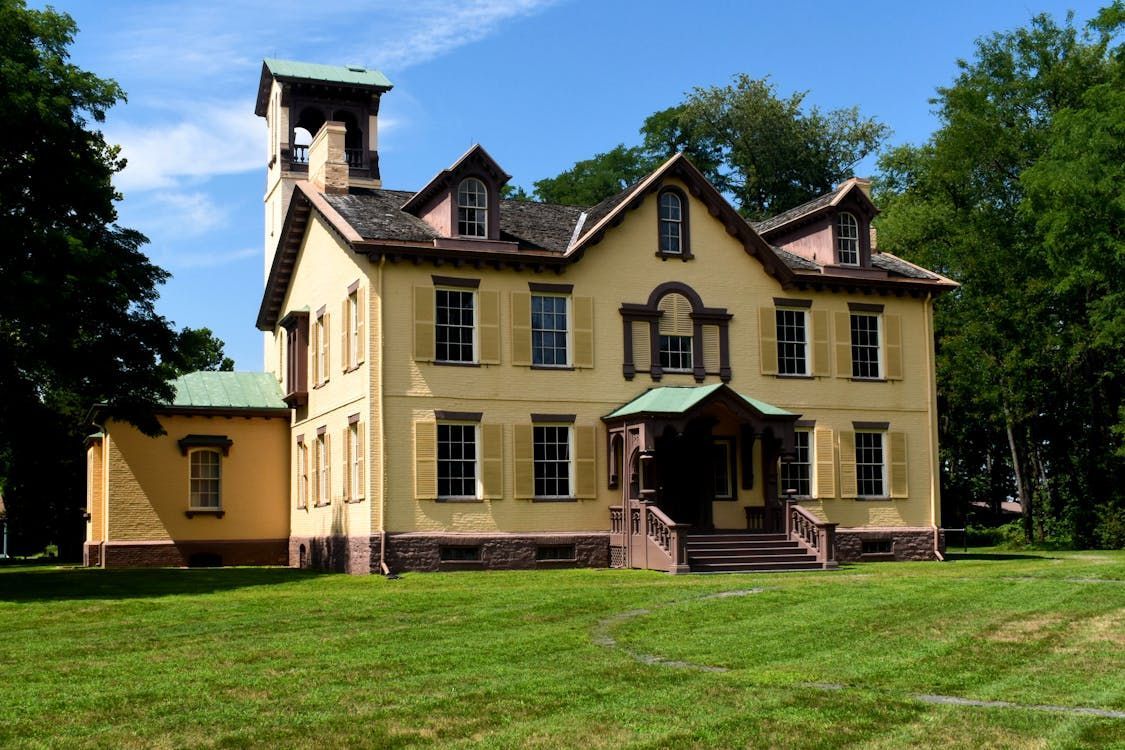
New Castle served as Delaware’s colonial capital during the 17th and 18th centuries. It was here, in 1776, that Delaware declared independence from both Pennsylvania and Great Britain, establishing itself as a state.

The city’s location by the Delaware River was key during colonial times, but it also made it susceptible to British naval attacks during the American Revolution. That was why the seat was moved to Dover, although it wasn’t made the permanent capital until the 1780s.

New Castle still keeps its well-preserved colonial architecture, particularly in the district surrounding its courthouse.

Geography Geography 4 min read

LET’S GIVE THAT TOURIST SPOT A REST

The Unbeaten Path: 10 Not-Too-Famous-Yet Cool Holiday Spots in America

Image: Rusty Watson

Are you tired of being met with hordes of people in every vacation spot you go to? Maybe the Instagram curse ruins every beautiful place making it crowded to no end. Or perhaps it is the fact that most people choose to go to the same places. If this happens to you, then know that you are not alone (no pun intended).

The good news is that many amazing places haven’t been "discovered" yet by the masses. We present you with ten beautiful spots that, while not untouched by the human hand, aren’t nearly as crowded as, say, Miami Beach. Some of them will probably surprise you for their nearness.

1
Block Island, Rhode Island

Image: John Angel

One of the "Last Great Places" in the Western Hemisphere, as declared by the Nature Conservancy, Block Island has done a great job at preserving its natural beauty, with 40% of its territory being devoted to wildlife refuges.

32 miles of coastline and inland trails, along with beaches, biking, and trekking provide ample opportunities for enjoying the great outdoors. And, when the sun goes down, a healthy scene of bars and restaurants with an easy-going atmosphere and great food welcomes visitors.

2
Alamosa, Colorado

Image: Shelby Cohron

Colorado is not just about ski resorts and mountains, as Alamosa proudly demonstrates. If you head down south in the Centennial State you will find this high-altitude agricultural community mainly known to UFO sightings chasers and birdwatchers.

The town, packed with antique shops and craft breweries, is near the Great Sand Dunes National Park, a surreal place that makes visitors feel as if they were in the Sahara desert. The San Luis Valley and the Sangre de Cristo mountains, also near, provide ideal spots for hiking and exploring during the summer months.

3
Ice Age Trail, Wisconsin

Image: Dave Hoefler

Hiking trails might not look like the most crowded places but they can be—the popular ones, at least. Wisconsin’s Ice Age Trail offers 1,200 miles of scenic hiking paths without the heavy foot traffic of places of most known trails.

The trail can be thoroughly enjoyed without the need to traverse it in full, as it has many segments that can be discovered individually. Wooded hills, gorgeous glacial lakes, and plenty of trailside camps and small communities to rest make this trail a great spot for a holiday in nature.

4
Pioneer Valley, Massachusetts

Image: Larry Ferreira

There is much more to Massachusetts than Boston, Cape Cod, and the Berkshires—for example, the Pioneer Valley . Carved by the Connecticut River, this peaceful area is home to several vintage mill cities turned into modern towns full of restaurants and one-off shops.

Hikers can walk the north woods on the New England Trail and Springfield visitors can discover the Naismith Memorial Basketball Hall of Fame, where the sport was born in 1891, as well as the Amazing World of Dr. Seuss Museum & Sculpture Garden.

5
John Day Region, Oregon

Image: Anna Vineyard

While it has managed to avoid massive crowds for all of its existence, it's hard to believe that a natural wonder as picturesque as John Day Region will remain a calm place for much longer in this day and age. Take a moment to Google-search John Day Region’ s Painted Hills and you will get the idea.

And if that is not enough reason to make you plan a visit, the region is packed with old-growth rainforests, canyons, high desert plains, and undammed rivers complete with sandy beaches and gorgeous meadows, all in an easy-to-move-around area.

6
Pennsylvania Wilds

Image: Lera Kogan

When considering the abundance of wildlife and untamed mountain creeks, ancient trees of the Forest Cathedral, and Pine Creek’s own version of the Grand Canyon, it becomes clear that the Pennsylvania Wilds is a region that lives up to its name.

Sprawling across a vast expanse of the rugged Allegheny Plateau, the region boasts 29 state parks, two national wild and scenic rivers, a world-class stargazing center at Cherry Springs, and human relics like the Kinzua Bridge.

7
Tulsa, Oklahoma

Image: Drew Harbour

A city that has a ton of amazing things to offer but never appears on those glamorous Top-Cities-To-Visit lists, Tulsa is a hidden jewel of the Midwest. Its beautiful Art Deco architecture, impressive museums and cultural institutions with collections rivaling those of major cities, lively music scene, and craft breweries make it a great long weekend destination.

The best time window to visit would be from September to November when the temperate weather is ideal for walking tours and bike rides in the historic neighborhoods. The Tulsa International Airport has nonstop flights from all over the country, all year long.

8
Cumberland Island National Seashore, Georgia

Image: Parker Hilton

Combining beach fun and outdoor adventure with copious wildlife, Cumberland Island National Seashore receives visits that usually stay for the day. But staying overnight at beachside campgrounds or the Greyfield Inn is a fun adventure as well.

Georgia’s largest and southernmost barrier island is full of wild horses, sea turtles, wild turkeys, and infinite birds everywhere to be seen along the island’s 18-mile-long beach.

9
Western Tennessee

Image: Joshua J. Cotten

An enticing blend of nature, history, music, and food tells us that there is so much more to Tennessee than the tourist magnet that is Nashville. From the cradle of blues, soul, and rock ‘n’ roll that is Memphis to the historical sites of Shiloh National Military Park and Fort Donelson National Battlefield to the Meeman-Shelby Forest State Park that conserves nearly 13,000 acres of rare hardwood bottomland along the Mississippi River, including eerie bald cypress swamp. Western Tennessee is a place to explore.

10
Ouachita Mountains, Arkansas

Image: Oliver Graham

The few visitors who venture past Hot Springs National Park, and into the highlands of west-central Arkansas are rewarded with a haven of solitude and natural wonder in the form of the Ouachita range.

These mountains are ideal for those who like their hiking, camping, and fishing in a peaceful environment. And, if that proves to be too calm, Magazine Mountain is a regional hang-gliding mecca that also boasts amazing mountain biking routes.

Explore more American facts

Choose your favorite category!

General
General

As American as apple pie—the very best America has to offer!

Culture
Culture

Delve into the astounding richness of American lore.

Geography
Geography

Hop in and explore vast and diverse American landscapes.

History
History

Discover the key moments that shaped the United States.