Geography Geography 4 min read

Thriving in the heat

Resistant to cactus spines! Meet the Mojave Desert's toughest creatures

Image: Dennis Thompson / PetrCZ

The desert can be one of the most dangerous environments for humans. However, despite the harsh conditions, a surprising number of species not only can survive but also exhibit incredible traits and abilities. If you're ready to meet 10 of these powerful (and, we must admit, threatening) creatures, keep reading!

1
Chuckwalla

Image: Matthew Mentley

The chuckwalla can grow up to 16 inches long, making it one of the largest desert lizards. However, its size isn't the most impressive thing about it. What sets it apart from the rest is its ability to inflate like a balloon to twice its size! That's right; chuckwallas inflate their bodies to fit perfectly into holes and crevices in rocks, making it nearly impossible for predators to pull them out.

As if that weren't enough, these lizards live in desert environments with virtually no water. Although they do take in some liquid, most of their hydration comes from the plants they eat.

2
Kangaroo rat

Image: Michael Jerrard

The incredible kangaroo rat is a specialist in surviving the harshest environments. One of its talents is construction; this rodent knows how to build elaborate burrows in sandy soils for shelter and protection. In addition, kangaroo rats have fur-lined cheek pouches that allow them to carry food from where they find it back to their burrows.

But what makes them unique is their jumping ability. As small rodents (just 3.5 to 5.5 inches), their leap is surprising: they can reach up to 9 feet in a single bound! Plus, like the chuckwalla, the kangaroo rat also survives in the desert on minimal water intake.

3
Gila monster

Image: David Clode

The Gila monster is as famous as it is amazing. This reptile, native to the southwestern United States and northern Mexico, stands out for its unique appearance: a dark, scaly skin with pink or orange spots. In addition, the Gila monster has something that makes it special: it's one of only two venomous lizards in North America. Its potent venom is full of neurotoxins that affect the nervous system of its prey, causing intense pain, swelling, bruising, and even paralysis.

4
Mojave green rattlesnake
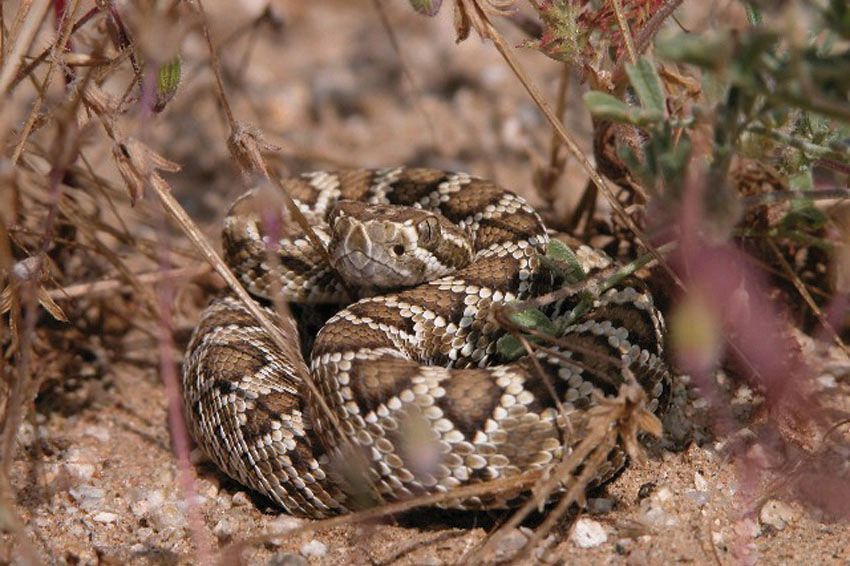
Image: Joshua J. Cotten

While any snake can be terrifying to most of us, the Mojave Green Rattlesnake stands out for several reasons.

The crotalus scutulatus —according to its scientific name— is distinguished by its greenish hue, which not only gives it its characteristic nickname but also helps it camouflage in the desert sand. This snake is not only venomous but is considered one of the most dangerous rattlesnakes! Its potent venom contains neurotoxins that, if left untreated with antivenom, can be lethal to various species, including humans.

5
Cactus wren

Image: Carol Lee

You've probably tried transplanting a cactus or got close to one, only to end up with tiny thorns that pricked you for days. But this doesn't happen to the cactus wren, an amazing bird known for its exceptional adaptation to the desert.

As its name implies, one of the most impressive features of the cactus wren is its ability to build large and sturdy nests on cacti without getting hurt. As if that weren't impressive enough, the bird's cleverness leads it to cover its nest with snakeskin to discourage potential predators. Incredible, right?

6
Green tarantula

Image: Thomas Oldenburger

Spiders are among the most feared creatures by humans. But if there's one spider that could scare even the bravest, it's the Mojave green tarantula, which can grow up to 4 inches long and has legs that span up to 6 inches!

Its venom delivers intense pain to its prey while simultaneously paralyzing them. In addition, these tarantulas have urticating hairs that irritate predators' skin, eyes, and respiratory systems. On the other hand, one of their great traits is their lifespan: This species can live up to 25 years in the wild!

7
Sidewinder rattlesnake

Image: Michael Jerrard

The sidewinder rattlesnake is definitely one of the desert bosses. You can tell it’s dangerous just by seeing it: Its typical triangular, flat head is topped with two horns that don't look friendly at all.

But what makes it a unique species is its movement pattern. This snake doesn't move in a straight line but in a sidewinding motion, lifting its body off the ground in a zigzag pattern. That allows it to confuse its prey while moving quickly without getting burned by the hot sand.

8
Pinyon jay

Image: frank mckenna

The cactus wren is not the only bird on this list; the pinyon jay also has its place. Nicknamed "forest farmers," pinyon jays bury the seeds of pinyon pines to eat later. The seeds they leave uneaten sprout into new pines, creating a symbiotic relationship between tree and bird. Even more impressive is their incredible memory: pinyon jays can remember thousands of seed burial locations, even months after hiding them!

9
Desert tortoise

Image: Abraham Weiss

Unlike bears and other animals that hibernate during the winter, desert tortoises enter a form of hibernation known as brumation. This occurs when it's very hot to save energy and they need to protect themselves from the heat. To do so, desert tortoises create deep burrows using their strong, shovel-like front legs. In addition, they can live up to 50 years in the wild, making them one of the longest-living reptiles.

10
Bark Scorpion

Image: Andrey Tikhonovskiy

When it comes to danger, the Bark Scorpion of the Mojave Desert is also one of the stars on this list. Considered one of the most dangerous scorpions in all of North America, this arachnid has a light yellowish body with darker spots. It tends to hide under rocks or trees, so you know where to be most careful. While it's not famous for attacking humans, it may sting if it feels threatened.

Geography Geography 4 min read

Let’s take a quick roadtrip

Discover our 49th state with these 10 gorgeous locations in Alaska!

Image: Rod Long

There’s a reason Alaska is known as "The Last Frontier." This state often feels like a remote and isolated location, yet it is undeniably filled with natural beauty. However, don’t let the nickname discourage you from exploring the wonders Alaska has to offer. As cold as this state’s temperatures can get, they are balanced by the warmth of its citizens and the breathtaking landscapes it is home to. With that in mind, we have decided to pay homage to 10 of the most stunning locations in Alaska, in the hope that you might consider them for your next visit. Enjoy!

1
Denali

Image: Barth Bailey

We’ll start with what many believe to be Alaska’s crown jewel. Formerly known as Mount McKinley, Denali is the highest peak in North America, with a summit elevation of 20,310 feet above sea level. Its height is matched only by its magnificence—a snow-covered wonder adorning the Alaskan skyline.

The name "Denali" comes from the Koyukon Athabaskans, who are native to the region. They referred to the mountain as Dinale or Denali, which is believed to be a Koyukon word meaning "high" or "tall." Over the years, many mountaineers have attempted to reach the peak, with the first successful ascent dating back to 1913.

2
Chugach State Park

Image: Paxson Woelber

East of the city of Anchorage lies Chugach State Park , a 495,204-acre state park that houses the stunning Chugach Mountains. However, this park is more than just a scenic landscape; it plays a crucial role in ensuring that the residents of Anchorage have access to safe drinking water.

Chugach State Park is also home to Eklutna Lake, which offers numerous recreational opportunities, including fishing, camping, and hiking. The park supports a diverse array of wildlife, including moose and bears.

3
Kayak Island

Image: Ty Fiero

In 1826, Lt. Sarychev of the Russian Navy noticed the peculiar shape of a certain island located in the Gulf of Alaska. Because it resembled a specific type of boat, Sarychev named the island Kayak Island , unaware that he was christening one of Alaska’s most stunning destinations.

Kayak Island is considered historically significant since it was the first place where a non-native set foot in Alaska. Notably, the island was visited by the famed explorer Captain James Cook in 1778. During this visit, Captain Cook left an empty bottle at the base of a prominent tree. Inside the bottle was a message and two pieces of silver gifted to him by the English crown.

4
Kodiak Island

Image: Brent Jones

Next, we have Kodiak Island , the second-largest island in the United States. Over two-thirds of the island is occupied by the Kodiak National Wildlife Refuge, which protects a diverse range of wildlife, including the Kodiak bear, Roosevelt elk, and Sitka black-tailed deer.

While no entry is allowed to the refuge, the island still has plenty to offer visitors. For example, you can experience the island’s beauty at the Buskin River State Recreation Site, which features camping, fishing, and scenic beaches.

5
Kenai Fjords National Park

Image: Kedar Gadge

Fjords are a truly unique natural wonder that can only be found in a few places in the world, and Alaska is home to one of the most beautiful of its kind. Located on the Kenai Peninsula, west of the town of Seward, Kenai Fjords National Park is a breathtaking expanse of glaciers, islands, and wildlife.

With a total area of 669,984 acres, Kenai Fjords is relatively small—approximately 90% the size of Yosemite. Regardless, of what this park lacks in size, it more than makes up for in accessibility, diversity, and, above all, natural beauty. It is home to the Harding Icefield, one of the largest ice fields in the United States, as well as an impressive variety of wildlife, including black bears, sea otters, and killer whales.

6
Wrangell-St. Elias National Park & Preserve

Image: Grace Simoneau

As the largest American state by landmass, it seems only fitting that Alaska is home to the largest national park in the United States. Wrangell–St. Elias National Park and Preserve encompasses the Wrangell Mountains and a significant portion of the Saint Elias Mountains, including Mount Saint Elias, the second-highest peak in both the United States and Canada.

Besides many species of animals like the grizzly bear and the timber wolf, this park is home to Mount Wrangell and Mount Churchill—two of the largest volcanoes in the region. Not only that, the abandoned buildings of a former copper mining operation within the park have been designated a National Historic Landmark district.

7
Glacier Bay National Park and Preserve

Image: Joseph Corl

Don’t be surprised by the number of stunning glaciers that made it onto this list—after all, these natural wonders are Alaska’s pride and joy. With that in mind, here’s the first entry in our selection of beautiful glaciers you should definitely visit: Glacier Bay National Park and Preserve.

The park houses 7 glaciers in the park, out of which the Margerie Glacier is probably the most famous. This iconic glacier attracts thousands of tourists each year, with nearly 80% arriving via cruise ships. Not only that, the park also offers several other outdoor activities like kayaking, camping, fishing, and bird-watching.

8
Hubbard Glacier

Image: Mick Kirchman

Located within the previously mentioned Wrangell–St. Elias National Park and Preserve, Hubbard Glacier undoubtedly deserves its own spotlight. This stunning glacier can be found right on the border between Alaska and Canada, with part of it extending into Kluane National Park and Reserve in Yukon.

Hubbard Glacier is primarily visited by tour and cruise ships since it can’t be reached by land. Regardless, experiencing the beauty of this natural wonder requires nothing more than gazing upon its majestic presence.

9
Worthington Glacier

Image: Grace Simoneau

Worthington Glacier holds the distinction of being one of the few US glaciers that can be easily accessed via a paved highway. Located approximately 30 miles east of the city of Valdez, this glacier is truly a sight to behold.

Covering 5,774 acres, this breathtaking glacier was designated a National Natural Landmark in 1968. If you’re planning a visit, consider stopping at the Worthington Glacier State Recreation Site, a comfortable state roadside park that offers a stunning view of the glacier.

Explore more American facts

Choose your favorite category!

General
General

As American as apple pie—the very best America has to offer!

Culture
Culture

Delve into the astounding richness of American lore.

Geography
Geography

Hop in and explore vast and diverse American landscapes.

History
History

Discover the key moments that shaped the United States.