Geography Geography 3 min read

A deep look at the map

America’s place names have wild origins – here are 12 of the strangest

Image: Mackenzie Cruz

Every place name has a story— especially in America ! While some come from Indigenous languages, others trace their origins to European tongues or ancient legends. These names are more than just labels; they offer glimpses into our past , revealing the diverse cultures and pivotal events that have shaped the nation. From Greek influences to names that predate European conquest, we've gathered 12 of the most fascinating origins behind America's place names.

1
Miami

Image: Avi Werde

Miami’s name comes from the Mayaimi people, who lived around Lake Okeechobee. The name itself is thought to refer to the "big water" of the lake, a defining feature for the region's Indigenous inhabitants.

2
Chicago

Image: Neal Kharawala

The name "Chicago" comes from the Potawatomi word shikaakwa, meaning "wild onion" or "wild garlic." These plants were once abundant along the banks of the Chicago River, and early French explorers who heard this term adapted it into the city's name.

3
Philadelphia

Image: Chris Murray

The name "Philadelphia" comes from the Greek words philos (love) and adelphos (brother). Founded in 1682 by William Penn, the city was intended to be a haven for religious freedom and peaceful coexistence—hence its name.

4
Cincinnati

Image: Matt Koffel

Cincinnati's name comes from the Society of the Cincinnati, a patriotic organization formed in 1783 to honor officers of the Continental Army. The society itself was named after Lucius Quinctius Cincinnatus, a legendary hero of the Roman Republic.

5
California

Image: Vital Sinkevich

The name "California" comes from Las Sergas de Esplandián, a 16th-century Spanish novel by Garci Rodríguez de Montalvo. The book describes a mythical island where gold could be found in great quantities. When Spanish explorers reached the Baja Peninsula, they mistakenly believed it was an island and, inspired by the novel, named it after the fictional paradise.

6
Boise

Image: Attorney Sluice

The name "Boise" comes from the French word boisé, meaning "wooded" or "forest." French fur traders were some of the earliest European explorers in the region, and they named the Boise River after observing the thick forests that lined its banks.

7
Albuquerque

Image: Raychel Sanner

Albuquerque was named by the Spanish in the 18th century, but its origins trace back to the Latin words albus (white) and quercus (oak), referring to the white oak trees that are found in the area.

8
Mississippi River

Image: Mathew Benoit

The Mississippi River gets its name from the Ojibwe word Misi-ziibi, meaning "Great River." Certainly a fitting name, given the river’s key role in the development of American trade and transportation, a vital route for settlers and Indigenous people alike.

9
Yellowstone National Park
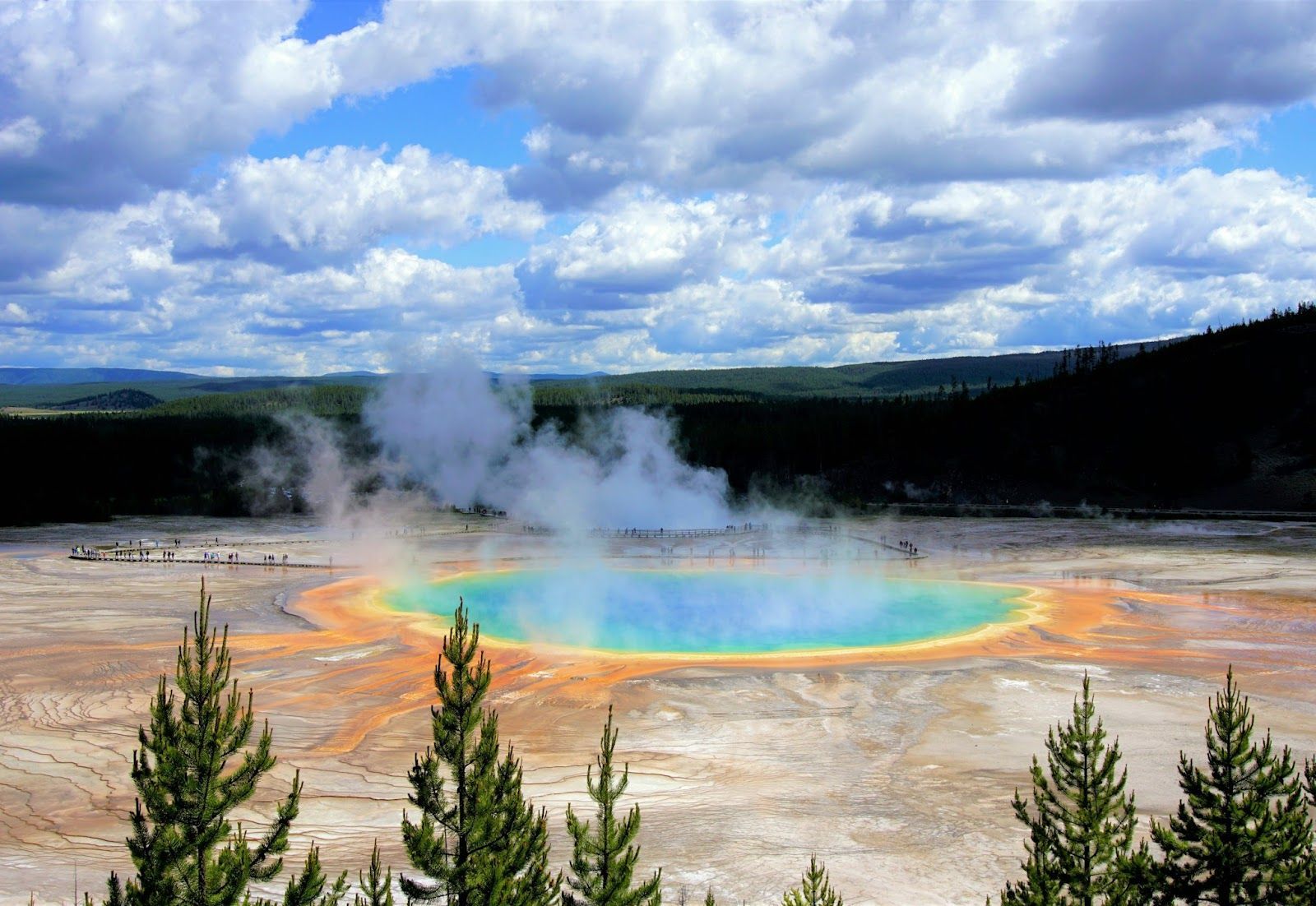
Image: Meina Yin

Yellowstone National Park takes its name from the Yellowstone River, which was in turn named by fur trappers who used the word "yellow" to describe the river’s striking sandstone cliffs . Established in 1872, Yellowstone became the first national park in the U.S., preserving its unique geological and natural wonders.

10
Appalachian Mountains

Image: Elijah Mears

The Appalachian Mountains, among the oldest in the world, take their name from Apalachee , a term used by the Spanish to refer to a Native American tribe in northwestern Florida . Interestingly, the name was later applied to the distant mountain range, despite no direct connection between the two—perhaps they had run out of names?

11
Niagara Falls

Image: Sergey Pesterev

Niagara Falls takes its name from the nearby Niagara River, which derives from the Iroquois word Onguiaahra , meaning "the strait" or "narrow water." Unsurprisingly, given their breathtaking beauty, the falls have long been a significant natural landmark for both Indigenous peoples and European explorers.

12
Adirondack Mountains

Image: Ty Finck

The Adirondack Mountains in New York are believed to take their name from the Algonquin word adirondacks , meaning "they eat trees" or "bark eaters." This name likely referred to another group of Indigenous inhabitants who relied on the region’s lush forests for food and shelter.

Culture Culture 5 min read

LEGENDS OF THE ROAD

Let's Check Out 10 of America's Most Iconic Cars!

American cars have an unquestionable charm that's difficult to put into words. But it is worth trying! Whether you're a car fan captivated by engines or someone who simply appreciates the overwhelming beauty of legends like the Ford Model T or the powerful Dodge Charger , you'll enjoy this article, as the history and features of these cars are deeply linked with American culture. Join us on this road trip through these 10 iconic American car models that have shaped automotive history. Some might agree with our choice for the tenth spot, while others may not ; we want to hear your opinion!

1
Ford Mustang

Image: VizAforMemories

Often referred to simply as "the Mustang ," this series manufactured by Ford is one of the quintessential American automobiles.

The Mustang was born in 1964 and has been in production ever since (with the Mustang II being produced from 1974 to 1978), as its popularity transcends borders. Its smart, sporty design has evolved over the years, but it has never lost its pony car label.

Loved by many for its wide range of engine options and powerful performance, the Mustang is more than just a car; it's an icon of American automotive culture. Remember the Mustang GT 390 in the 1968 movie Bullitt ?

2
Chevrolet Corvette

Image: Abdul Bakar

With its iconic two-seater design and a very rich history, the Corvette is a legend that could not be left out of this list.

The Corvette was introduced by Chevrolet in 1953 , some 70 years ago! However, it has aged like fine wine. Far from being out of style, this classic remains a top choice for car enthusiasts worldwide, blending performance, design, heritage, and status.

And as if all that wasn't enough, the Corvette has multiple victories in prestigious endurance races such as the American Le Mans Series .

Fun fact: the Corvette gets its name from a small, fast type of warship!

3
Jeep Wrangler

Image: cody lannom

Famous for its off-road prowess, the Jeep Wrangler is definitely an icon.

The origin of this car perfectly explains its capacity. The Jeep Wrangler has its roots in the Willys MB , a military vehicle used during WWII, renowned for its rugged durability. Of course, the Wrangler has evolved into the version we know today, blending practicality and durability, and displaying features like removable doors .

The Jeep Wrangler's off-road expertise has earned it a global reputation that is hard to beat. As you might already know, a rugged Jeep Wrangler YJ appears in the iconic Jurassic Park . After all, no other car could handle dinosaurs!

4
Ford Model T

Image: Philip Schroeder

Who could forget the iconic Ford Model T ? A car instantly recognizable to everyone, whether you're a car lover or not.

Ford began producing the Model T in 1908 and ceased production in 1927. But in less than 20 years, over 15 million units were made! This incredible feat makes the Model T one of the best-selling cars in history.

As if its beauty wasn't enough, the T was also renowned for its durability and affordability , specifically designed to be accessible to the average American. Do you want to know how much the "Tin Lizzie" cost when it started revolutionizing the streets in the early 20th century? Initially, it was priced at around $850 , but its price even dropped in the years that followed!

5
Cadillac Escalade

Image: Craig Marolf

When Cadillac decided to enter the SUV market, it did so in a big way. In 1998 , the brand released one of its most acclaimed models: the Cadillac Escalade . Imposing from every angle, this SUV has a luxurious design both inside and out, with the quality and style that characterizes the brand.

Beyond its powerful performance, the Escalade distinguishes itself with leading technology . This includes multiple USB ports, high-quality sound systems, and advanced driver assistance systems.

With all these advantages, the Escalade became one of Cadillac's best-sellers and also a popular choice in the luxury SUV market!

6
Ford Thunderbird

Image: Maxim Simonov

In 1955 , Ford spiced up the car scene with their Ford Thunderbird , a stylish two-seat sports car. Quickly becoming an icon, this model was Ford's answer to Chevrolet's Corvette.

The " T-Bird ," as it came to be known, evolved over its production run. In 1961, a significant transformation occurred: it became a four-seat model. With its new sleek design, the Thunderbird earned a new nickname and became the " Bullet Bird ."

Over the years, Ford produced 11 generations of the Thunderbird, each with unique features. Unfortunately, Ford decided to stop production of the T-Bird in 2005 due to declining sales. However, its exceptional qualities and profound impact have made it one of America's classics.

7
Dodge Charger

Image: Tim Meyer

A legendary American muscle car , the Dodge Charger appeared in 1966 , right amid the dynamic 60s and 70s era.

You probably remember the first-generation Dodge Charger, which featured hidden headlights , something quite remarkable in its time! Its V8 engines and high-performance capacities also made it a star in the TV series " The Dukes of Hazzard ."

With many variations over the years, Dodge continues to produce the model to this day, always updating its technology but maintaining some of the main features of its iconic design. Are you among the many fans of this amazing model?

8
Pontiac GTO

Image: Vitali Adutskevich

If we talk about muscle cars , we cannot forget the Pontiac GTO . Born in 1963 , it became an instant hit, produced for eleven years until 1974 . It also made a comeback from 2004 to 2006, creating a new chapter in its history.

Considered by many as the perfect muscle car, the Pontiac GTO stood out for its powerful V8 front engine and its attractive design, which included dual exhausts and hood scoops. It was also available in a wide range of colors.

If you're wondering about its name, the abbreviation "GTO" stands for "Gran Turismo Omologato," Italian for "Grand Touring Homologated."

9
Chevrolet Camaro

Image: Tim Meyer

Classified as a pony car , the Camaro appeared in 1966 as Chevrolet's card to compete with the Ford Mustang. While maintaining its efficiency, speed, and powerful performance , the Chevrolet Camaro has seen its engines evolve across generations, ranging from V6s to V8s.

According to the legend surrounding its creation, the name of this famous model was conceived by Chevrolet's merchandising manager, Bob Lund. While flipping through an English-French dictionary, he found the French word c amaro , which translates as "friend, pal, or comrade." And that was exactly what the brand was looking for in its new pony car: to be a reliable companion for its owner.

10
Tesla Model S

Image: Jp Valery

Despite being a relatively new brand, Tesla has proven that it's more than capable of creating iconic cars.

A good example is the Tesla Model S , an all- electric luxury car that's relatively young, debuting in 2012 . Upon its introduction, it caused a sensation with its spectacular design and technology .

One of the most unique features of this model is its incredible speed. It can accelerate from 0 to 60 mph in 2.3 seconds! That's the definition of fast. It is also capable of traveling up to 370 miles on a single charge , highlighting its efficiency among electric cars. Of course, the vehicle's functions are controlled through an elegant touchscreen display. Can you imagine yourself driving this model?

History History 5 min read

First Family, regular domestic problems

Ten ways the First Family changed the White House

Since 1800, the house at 1600 Pennsylvania Avenue has served as the president’s official residence. In the more than 200 years since, the presidential mansion has seen it all, from being set on fire by British forces to having planes crash on its lawn. Each administration has left its mark on the White House, with many presidents and first ladies expanding, renovating, and reimagining it while creating new traditions and customs. Let’s dive into 10 ways First Families changed the presidential residence.

New Year Reception (John and Abigail Adams)

Image: Ray Hennessy

John Adams was the first U.S. president to live in the White House—then referred to as the President’s Palace or the Presidential Mansion—alongside his wife, Abigail, who played a significant role in furnishing the newly built residence.

On New Year’s Day in 1801, the Adamses held a public reception for anyone who wanted to shake hands with the president and his wife. This tradition continued (with some interruptions) until 1932, when it was ended by Franklin D. Roosevelt, who allegedly wanted to avoid being seen using a wheelchair.

Indoor Toilets (Thomas Jefferson)

When Thomas Jefferson assumed the presidency, he discovered that the White House lacked indoor plumbing, toilets, and had only an outdoor wooden privy. He ordered the construction of two "water closets," one on each side of the residence.

During Jefferson’s tenure, the White House underwent several modernizations, including improvements to the lighting system, the kitchen, and exterior features such as gutters. He also had an outdoor wine cellar built to store his extensive collection.

White House China (James Monroe)

Did you know the White House has a special room dedicated to displaying the porcelain sets designed for each administration? The tradition of commissioning presidential china designs started in 1817, with President James Monroe.

Monroe’s china was designed and crafted in Paris, featuring an eagle carrying a red, white, and blue banner inscribed with "E Pluribus Unum." Following criticism over the presidential mansion’s purchase of foreign-made goods, Congress decided that future presidential china should be manufactured in the United States, though some presidential couples still chose to commission French china.

The Library (Abigail Fillmore)

When Millard and Abigail Fillmore moved into the White House, their approach to decoration and improvement differed from that of previous First Families. None of them came from a wealthy background, so they prioritized expanding the heating system and modernizing the kitchen.

More interested in intellectual pursuits than in socializing, Abigail noticed that the Presidential Mansion lacked a library and set out to create one. She personally organized the room, selected the books, and arranged them to her liking. The library became her main parlor, where she received literary figures of the time and listened to music.

Floral Arrangements (Lucy Webb Hayes)

A passionate abolitionist and the first First Lady to earn a college degree, Lucy Webb Hayes moved into the White House at the end of the Reconstruction era, and after a highly controversial election. With limited funds to renovate the presidential mansion, Mrs. Hayes found ingenious ways to conceal holes in the carpets and worn-down furniture.

Lucy Hayes was the first president’s wife to be referred to as "First Lady." She made several improvements to the White House, but she is most remembered for turning the billiard room into a greenhouse filled with flowers, which she then used for floral arrangements for the residence.

The West Wing (Theodore Roosevelt)

We all know that the West Wing is where the presidential office is located, but not everyone knows that it was not part of the original design of the White House. Before 1902, the president’s offices were located on the second floor.

When Theodore Roosevelt moved into the White House, he discovered there wasn’t enough space for his six children and the growing staff. His wife, Edith, suggested that the second floor be converted entirely into family living quarters and that the offices be moved elsewhere. The West Wing was then built as a temporary structure on the site of the old stables, but in the end, it became a permanent fixture of the residence.

The Oval Office (William Taft)

This office is known as the place where major decisions are made, but it wasn’t part of the White House’s original design. When President William Taft decided to make the temporary West Wing permanent, he also doubled its size and created the first Oval Office.

Its distinctive shape was inspired by the semicircular Blue Room in the main residence, where presidents traditionally received guests. That design, in turn, paid homage to the bow windows from which George Washington once greeted visitors at his presidential homes in New York and Philadelphia.

Interior Reconstruction (Harry S. Truman)

By 1949, the White House had endured a century and a half of wars, fires, political scandals, and modernization. With few renovations made during the Great Depression and World War II, President Truman and his family moved into a mansion that was literally falling apart—it was declared unsafe after a piano leg crashed through the floor of the family quarters.

The Trumans moved across the street during the three years the reconstruction took place. Due to the need for extensive renovations, a total demolition of the building was considered but not enacted. In the end, the decision was to preserve the exterior walls and completely rebuild and expand the interior.

Themed Christmases (Jackie Kennedy)

The White House’s themed Christmas celebrations are now a beloved tradition, complete with a spectacular tree and elaborate decorations. This lovely tradition was started in 1961 by Jackie Kennedy, who then chose The Nutcracker as a theme, and featured decorations crafted by disabled and elderly citizens.

Since then, First Families have carried on the themed Christmas tradition, honoring topics and interests relevant to the nation and highlighting causes dear to the presidential family.

Office of the First Lady (Rosalynn Carter)

First Ladies have always played an important role in supporting the president, managing the Presidential Mansion, and championing various causes. However, this role wasn’t always officially recognized or included in the White House budget.

Although some First Ladies before her had hired official staff, Rosalynn Carter was the first to organize hers into a formal Office of the First Lady , complete with departments dedicated to press, social causes, campaigns, and community outreach.

Explore more American facts

Choose your favorite category!

General
General

As American as apple pie—the very best America has to offer!

Culture
Culture

Delve into the astounding richness of American lore.

Geography
Geography

Hop in and explore vast and diverse American landscapes.

History
History

Discover the key moments that shaped the United States.