Culture Culture 6 min read

How do the most powerful blow off steam?

Discover the unexpected hobbies and quirks of 12 US Presidents

Image: Robert LeRoy Knudsen, Public domain, via Wikimedia Commons

Running the White House is a highly demanding job, so throughout history, many presidents have found ways to relieve the pressure and stress of leading at the highest level of government. When not shaping the path of the nation, presidents have enjoyed a variety of hobbies and pastimes that provide them with leisure time to relax, unwind, and clear their minds. From golfing and swimming to reading and painting, here are 12 U.S. Presidents who found the perfect balance between pleasure and duty.

1
George Washington

Image: Alonzo Chappel, CC0, via Wikimedia Commons

Founding Father and first president of the United States, George Washington, enjoyed many recreational activities during his free time. He was a true outdoorsman—he loved hunting and fishing and was a devoted gardener and farmer .

It’s common knowledge that after deciding not to run for a third term, he retired to his Virginia farm and dedicated the rest of his life to farming. But one fact you may not know is that, in his youth, Washington was a frequent dancer —and rumor has it, he was even extremely good at it! He considered dancing an important social interaction, describing it as "so agreeable and innocent an amusement."

2
Franklin D. Roosevelt
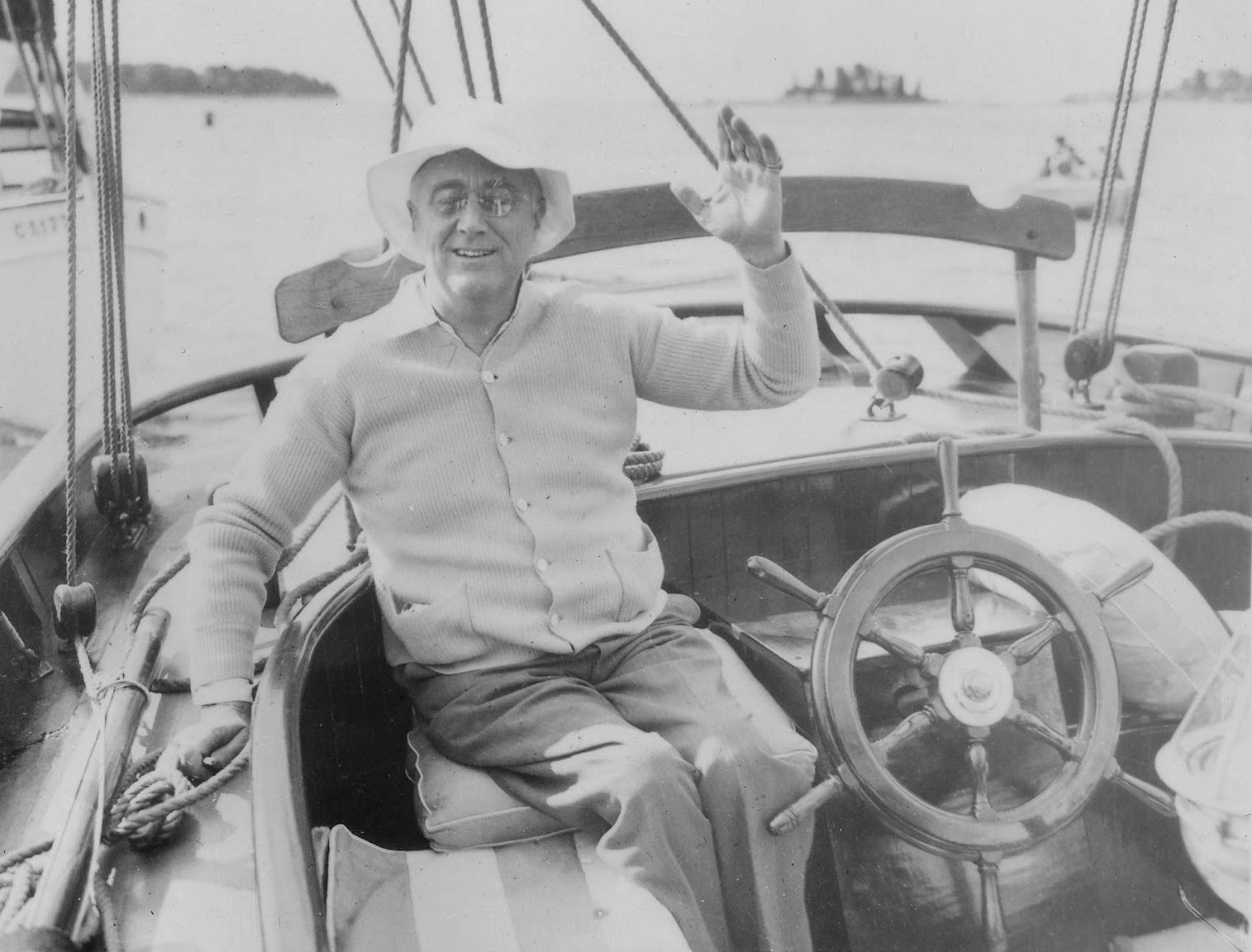
Image: National Archives and Records Administration, Public domain, via Wikimedia Commons

Franklin D. Roosevelt, the only president to be elected to four consecutive terms, led the country through the critical years of the Great Depression and World War II. To maintain a clear mind while navigating such tumultuous times, Roosevelt embraced a number of pastimes. He collected books , stamps , and ship models , for example.

In addition, he was an avid swimmer . After losing the ability to walk due to polio, Roosevelt began swimming three times a week to strengthen his muscles. Following his election, the New York Daily News donated a swimming pool to the White House so he could continue his practice.

3
James A. Garfield

Image: Unknown; part of Brady-Handy Photograph Collection., Public domain, via Wikimedia Commons

Before becoming the 20th president, James A. Garfield enjoyed fishing , hunting , and playing billiards . But he was also exceptionally intelligent and studious.

Though many people may know Garfield for serving just four months in office, he was also the first ambidextrous president of the United States . Not only could he write with both hands, but when asked a question, he could simultaneously write the answer in ancient Greek with one hand and Latin with the other. Pretty impressive, don’t you think?

4
Calvin Coolidge

Image: National Photo Company Collection, Public domain, via Wikimedia Commons

The 30th president of the United States liked riding horses so much that he had an electronic horse installed in the White House. The device had two speeds—trot and canter—and he rode it every day.

That said, Calvin Coolidge was a taciturn man of few words, who enjoyed taking afternoon naps, earning him the nickname "Silent Cal." He also had a very particular sense of humor . He reportedly enjoyed pressing the alarm buttons in the Oval Office or hiding in the garden shrubbery to startle his Secret Service agents.

5
Jimmy Carter

Image: Tuntematon, Valkoisen talon valokuvaajat (01/20/1977 - 01/20/1981), Public domain, via Wikimedia Commons

Throughout his life, Jimmy Carter was a curious man who never stopped doing things. He studied nuclear physics in college, could read two thousand words a minute, wrote numerous books, and even won a Nobel Peace Prize in 2002.

But what did this brilliant man like to do in his spare time? Carter had a variety of hobbies, including painting , poetry , tennis , cycling , fly fishing , and skiing . However, the one activity in which he perhaps excelled most was woodworking . After retiring, the 39th president of the United States set up a garage workshop on his Georgia ranch, where he built furniture that was later auctioned to benefit the Carter Center.

6
John Quincy Adams

Image: Pieter Van Huffel, 1769 - 1844, CC0, via Wikimedia Commons

John Quincy Adams was notoriously meticulous and kept a diary detailing his daily routine. Thanks to this, we now know that the sixth president of the United States liked to relieve the stress of the presidency with an early morning swim .

After waking up around 4 or 5 a.m., Adams would walk two miles to the Potomac River and leave his clothes on the shore before taking a swim. According to lore, one morning, a reporter named Anne Royall snatched his clothes and demanded that the president give her an interview. Adams had no choice but to answer her questions while standing deep in the river, completely naked.

7
Harry S. Truman

Image: Abbie Rowe, Public domain, via Wikimedia Commons

Harry S. Truman governed the United States from 1945 to 1953, right after World War II—a difficult and stressful time, to be sure. To blow off some steam, the 33rd president liked to immerse himself in one of his two long-time passions: reading and music .

Truman had eye problems, which prevented him from participating in sports. As a result, he became an avid reader from an early age—in fact, he once boasted of having read every book in the library by the age of 14. He was also a very skilled piano player , having started lessons at the age of seven.

8
Lyndon B. Johnson

Image: Yoichi Okamoto, Public domain, via Wikimedia Commons

Living up to the legacy of one of the most popular presidents in American history can't be easy. But it appears that the 36th president of the United States knew just how to maintain a good balance between responsibility and leisure. During his five-year administration, Lyndon B. Johnson spent 490 days —about a quarter of his presidency— at the LBJ Ranch in Stonewall , Texas, combining work and vacation so seamlessly that the place became known as "The Texas White House."

At this ranch, Johnson had an extensive collection of vehicles . Among them was the Amphicar, an amphibious passenger car built in the 1960s, which he used to play pranks on his visitors.

9
Richard Nixon

Image: White House Photographer, Public domain, via Wikimedia Commons

Not many people know this, but Richard Nixon was an artistic man. He enjoyed theater—he even met his future wife during a community theater audition—and he could play five musical instruments : piano, saxophone, violin, clarinet, and accordion.

But he was also into sports. In addition to being a huge football fan, he and First Lady Pat Nixon enjoyed bowling . In fact, the Nixons were responsible for moving the White House bowling alley back to the Executive Mansion after it had been relocated to a nearby building years earlier.

10
George W. Bush

Image: Series: Photographs Related to the George W. Bush Administration, 1/20/2001 - 1/20/2009Collection: Records of the White House Photo Office (George W. Bush Administration), 1/20/2001 - 1/20/2009, Public domain, via Wikimedia Commons

During his free time, George W. Bush enjoyed golfing, biking, attending baseball games, and reading American history. He was also a very competitive runner .

However, when the 43rd president of the United States left office, he was only 62 years old—plenty of time to acquire a new pastime. In the years following his time in the White House, Bush surprised many by turning to painting . "I’m a painter," he told Jay Leno on The Tonight Show .

11
Dwight D. Eisenhower

Image: ddd

To relieve the stress of leadership, Dwight D. Eisenhower maintained a number of hobbies that he cultivated throughout his life. One of his main passions was golf , which he played during and after his presidency. He even kept a small putting green in the White House garden and had a four-hole practice course installed at Camp David.

But that’s not all. Ike enjoyed fishing, hunting, shooting, watching Western movies, and playing bridge. He was also an avid painter who often captured natural landscapes and gave them as gifts to friends. After leaving the White House, Ike settled on a farm near Gettysburg, Pennsylvania, where he raised Black Angus show cows that won blue ribbons at state and county fairs.

12
John F. Kennedy

Image: Robert LeRoy Knudsen, Public domain, via Wikimedia Commons

John F. Kennedy was an exercise enthusiast and something of a jock. He played many sports : golf, tennis, swimming, baseball, and football. Despite being an athletic man, he enjoyed smoking between four and five cigars a day—his favorite brands were Upmanns and Monticellos!

But perhaps the hobby that most helped him relax from the tensions of the presidency was boating. Like many members of his family, John F. Kennedy loved to sail and was often photographed at sea with his wife and young children.

General General 4 min read

Behind the banners

11 U.S. state flags and their hidden meanings

Image: Drei Kubik

Flags are more than mere symbols—they tell stories, capturing the history, pride, and values of each state they represent. Every element, from colors to symbols, was thoughtfully chosen to convey a message tied to the spirit of the state. Join us on a journey across the country as we explore 11 unique state flags and the rich stories behind them.

1
Texas

Image: Joshua J. Cotten

Also known as the Lone Star, Texas’ flag features a single star on a vertical blue stripe, representing the state’s strong independent spirit. The red stripe represents courage, while the white stripe stands for purity.

In fact, the current design was adopted in 1839 during the Republic of Texas, echoing the state's history as an independent republic before joining the Union in 1845.

2
California

Image: Lesli Whitecotton

California's flag features a grizzly bear, a symbol of strength and independence. The star represents California's status as a republic in 1846 during the Bear Flag Revolt, and the red stripe signifies courage.

Interestingly, the bear depicted on the 1911 version of the flag is said to have been inspired by the last California grizzly bear held in captivity.

3
Arizona

Image: Denisse Leon

Arizona’s flag features a golden star surrounded by red and gold rays, symbolizing both the state’s arid landscape and copper mining industry. The blue and red colors are the same shade used on the flag of the United States.

The star commemorates Arizona’s statehood, achieved in 1912, while the thirteen rays symbolize the original Thirteen Colonies.

4
Colorado

Image: Courtney Cook

Colorado’s flag features blue, white, red, and yellow with a bold "C" encircling a golden disk. The blue symbolizes the sky, gold represents the state’s abundant sunshine, white the snowcapped Rockies, and red the "ruddy" earth.

The gold and white elements also honor Colorado’s gold and silver mining industries. Officially adopted in 1911, the flag stands as a tribute to the state’s natural beauty and pioneering heritage.

5
Florida

Image: Karl Callwood

Florida’s flag features a red cross with the state seal at the intersection. The cross represents the state's Spanish heritage, as it was originally founded by Spanish explorers.

The seal depicts a shoreline where a Seminole woman spreads flowers. While some suggest the woman represents the historical heroine Milly Francis, there is no evidence to support this theory. A Sabal palm and a steamboat complete the scene, reflecting Florida's vibrant scenery.

6
Maryland

Image: Gary Cole

Maryland’s flag stands out with its bold black and gold pattern, divided into quarters. The design incorporates elements from the family crest of the Calverts, the state’s founding family.

During the colonial era, Maryland used only the gold and black Calvert arms. The colors fell out of use after American independence but were reintroduced in 1854.

7
South Carolina

Image: Kelly

South Carolina’s flag features a white palmetto tree on a blue field, with a crescent moon beside it. The roots of this design have existed in some form since 1775, being based on one of the first American Revolutionary War flags.

An early version of this flag, known as the Moultrie Flag, was famously flown during the defense of a fortress on Sullivan's Island against the British fleet. The palmetto tree was later added as a symbol of the island’s successful defense.

8
Tennessee

Image: Brandon Hooper

Tennessee’s flag features three stars arranged in a triangular pattern, symbolizing the three regions of the state —East, Middle, and West Tennessee. The red, white, and blue colors align with the state’s commitment to unity and its place in the Union.

The current version, designed by Colonel Le Roy Reeves, was adopted in 1905. However, an earlier version already aimed to represent the state's three distinct regions with three slanted bars of red, white, and blue.

9
Hawaii

Image: little plant

Hawaii’s flag is unique among U.S. state flags. It features a Union Jack in the upper left corner, reflecting the historical ties between Britain and the Hawaiian Kingdom. It was first adopted in the early 19th century by the Kingdom of Hawaii and retained when the state joined the U.S. in 1959.

The eight horizontal stripes represent the eight main islands of Hawaii: Hawaiʻi, Maui, Kahoʻolawe, Lānaʻi, Molokaʻi, Oʻahu, Kauaʻi, and Niʻihau.

10
Indiana

Image: Lucas Beck

Indiana’s flag features a large gold torch, with 19 smaller stars surrounding it, representing Indiana's status as the 19th state to join the Union. The torch symbolizes enlightenment and the path to progress.

Adopted in 1917, the flag’s design was chosen through a contest offering a cash prize. The winning design, created by Paul Hadley of Mooresville, Indiana, was selected as the official flag with only minor modifications.

11
Maine

Image: Aubrey Odom

Maine’s flag features a shield with a pine tree at its center, flanked by a farmer and a sailor, representing the state’s agricultural and maritime heritage. The North Star above the shield symbolizes guidance and Maine’s motto, "Dirigo," meaning "I Lead."

The pine tree is a nod to Maine’s nickname as the Pine Tree State. Adopted in 1909, the flag’s design emphasizes Maine’s strong connection to its natural resources.

General General 5 min read

Are you home shopping?

Watch out! Here are 12 things to pay attention to when buying a home

Image: Dillon Kydd / Thirdman

Buying a house can be a nerve-wracking experience, especially for first-time buyers who might lack the necessary experience to do so with ease and confidence. Is the electrical system okay? What about the plumbing? Is there mold in the house? Is it too noisy? Is the neighborhood safe? These are all important questions homebuyers need to ask themselves when visiting a property. The following 12 are just a few of those questions, but they are definitely important ones. Can you think of anything else?

1
House Size

Image: Esther Zheng

One of the very first things any prospective homeowner should ask themselves is what kind of house they want . Having a general idea of the size, as well as the amount and type of spaces needed, is considered basic information before starting to look for a property.

2
Roof Condition

Image: Andreas Weiland

For practical reasons, most people looking to buy a house don’t inspect the roof of a prospective home. However, that section of the house can present serious and costly problems if it has any kind of damage.

Asking about the condition of the roof is paramount. How old is it? What is it made of? Buyers can find this information on the seller’s disclosure or ask the real estate agent to find out. Asphalt shingle roofs last around 20 years, but other materials, like clay or metal, can last much longer.

3
Neighborhood Safety

Image: Alev Takil

It goes without saying: safety is a big thing. When searching for a home, make sure the neighborhood where a potential house is located is safe. It’s also highly advisable to check out the neighborhood from an insider’s perspective via social media, such as Facebook groups, where you can learn more about the area and ask locals questions.

If you’re truly interested in a particular home, spend some time in the neighborhood. Go for a walk and check out local businesses to get a feel for what it’s like to live in the area.

4
HVAC system

Image: Taylor Vick

The HVAC system heats and cools a house year-round. Anyone looking at houses should ask about the type of heating and cooling system each one has and, most importantly, how old it is. Asking for maintenance records is also a good idea.

Furnaces and AC units typically last anywhere from 10 to 25 years. If a unit is broken, repair costs vary based on the type of system and how big it is. Homeowners can spend an average of $7,000 to replace an existing HVAC unit—but don’t count on a home warranty to automatically cover that.

5
Property Taxes

Image: Recha Oktaviani

A commonly overlooked item for first-time homeowners when searching for a house is property taxes. When considering a potential home, always compare property tax amounts over several years to help you calculate the overall affordability of the property .

To find out a home's estimated property taxes, check with the county's appraisal board. Homeowners Association dues should be listed in the home's listing, or you can request them from the listing agent.

6
Plumbing

Image: PAN XIAOZHEN

The plumbing system in a house can be a mystery for a prospective buyer if they don't know how to inspect it properly. Pipe disintegration, obstructive tree root growth, and complicated clogs can all cause havoc on the system. Keep in mind that sewer line replacement can cost anywhere from $1,300 to $4,900.

Always check toilets for leaks, unstable bases, and discoloration . Look under the bathroom and kitchen sinks for signs of leaks. Turn on the hot water in the sink or tub to see if it gets hot. If it doesn’t, that could indicate a problem with the water heater.

7
Water damage and mold

Image: Hydra 4x

Water damage can cause numerous problems in a house, including structural issues, mold, and rot, especially in basements. Anyone inspecting a house should pay close attention to musty smells as well as water stains on floors, walls, or ceilings .

The cost of mold removal can be anywhere from a few hundred to a few thousand dollars, depending on the size of the affected area. And, because mold is a health hazard, it should be treated before moving in.

8
Proper ventilation

Image: Jelleke Vanooteghem

This one might be subtle, but it’s very important, especially when considering the mold issues mentioned earlier. Without adequate interior ventilation, moisture can't evaporate , which can turn a room into a breeding ground for mold.

Look for condensation on windows or slightly bubbled or peeling paint around windows, doors, or vents. These signs may indicate moisture within the walls or ceiling drywall.

9
Noise Level

Image: Rei Kim

Nobody wants to live in a noisy home. But, at the same time, this issue is often overlooked when searching for houses. Many showings are cunningly scheduled during quiet hours to disguise the noise issues.

If you are truly interested in a property, visit during high-traffic hours to assess this concern . Even if the house is perfect in every other way, the constant hum of passing cars, public transport, or other sources of noise can become a serious problem.

10
Foundation and home exteriors

Image: Aiden Craver

Foundations matter. Bulging or bowing foundation walls are signs of structural weakness that can be expensive to repair. Always check for cracks in the foundation, drywall, or ceiling ; gaps above doors and windows ; sunken stairs or porches; and sloping or uneven floors or tiling.

Of course, not every crack means the home is about to collapse. Every home experiences some degree of settling, so some cracks are to be expected.

11
Electricity issues

Image: Mila Albrecht

The electrical system in a house can be compared to the nervous system of a human being: every part must work properly, and issues can sometimes be difficult to spot. From the power outlet next to the bed to other electrical systems in the house, like the garage door opener, everything is important and contributes to your safety and comfort. Bring a phone charger and plug it into random sockets to check if they work properly .

12
Room for improvement

Image: Daniel McCullough

Buying a house is a big investment and you can be living in it for a very long time. Therefore, it is always important to take into consideration any future plans and whether these plans make sense in that particular house.

Is there a wall you could knock out to create more space if needed? A garage or attic you could potentially finish if you need an extra room? Having an easy-to-modify layout can provide more possibilities for the future.

Explore more American facts

Choose your favorite category!

General
General

As American as apple pie—the very best America has to offer!

Culture
Culture

Delve into the astounding richness of American lore.

Geography
Geography

Hop in and explore vast and diverse American landscapes.

History
History

Discover the key moments that shaped the United States.