Geography Geography 3 min read

Let’s go book-gazing!

Beyond books: 11 breathtaking libraries you are going to want to visit

Image: Clay Banks

Whether you're a book lover or not, there's something magical about stepping into a beautiful library—the scent of old volumes, the quiet hum of readers, and the sheer architectural grandeur. Some libraries across the US are among the most enchanting places you can walk into. Here is a list of 11 stunning libraries worth exploring, even if you're not a bookworm!

1
Library of Congress

Image: Vincent Yuan @USA

Of course—the beating heart of American knowledge! As the largest library in the country and the world , it holds millions of books, rare manuscripts, and historical treasures.

Its grandeur isn’t just in its collection. Take the Thomas Jefferson Building: with its elaborate ceilings, marble columns, and frescoes, stepping inside feels like walking into a cathedral. Ever wanted to see an original Gutenberg Bible? This is the place.

2
New York Public Library

Image: Ran Ding

Patience and Fortitude stand guard—those are the two iconic stone lions flanking the entrance. The New York Public Library’s main branch is a true city landmark.

Step inside the Stephen A. Schwarzman Building, with its grand marble-lined halls and sweeping staircases. Don’t miss the Rose Main Reading Room —an awe-inspiring space adorned with murals, chandeliers, and rows of inviting wooden tables.

3
Boston Public Library
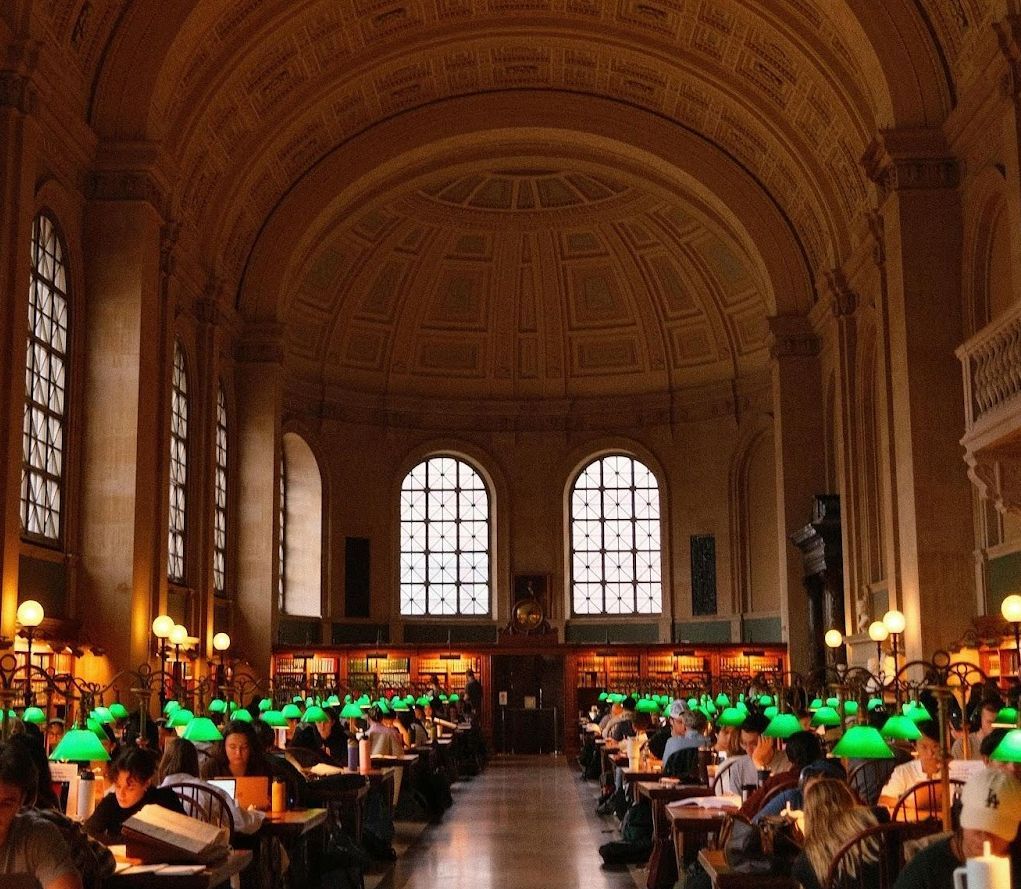
Image: Wendy Wei

A library so impressive it feels like it should charge an admission fee—but lucky for us, it doesn’t! Established in 1848, it was the first large free municipal library in the United States.

It’s home to Bates Hall, a stunning reading room with soaring barrel-vaulted ceilings and warm oak tables—a dream setting for book lovers.

4
Seattle Central Library

Image: Sylvia Yang

A sharp contrast to the historic beauties on this list, but no less worthy of inclusion. The Seattle Central Library is a futuristic masterpiece.

Designed by renowned architect Rem Koolhaas, its bold glass-and-steel exterior is impossible to miss. Inside, multi-level platforms create a space that feels more like a sci-fi movie set than a traditional library.

5
Geisel Library at the University of California, San Diego

Image: Jeremy Huang

Named after none other than Dr. Seuss himself (real name: Theodor Geisel) and his wife, Audrey, this library looks like something straight out of a sci-fi novel.

Its unique Brutalist-meets-futuristic design makes it one of UCSD’s most recognizable landmarks. It houses an extensive collection—but let’s be honest, the main draw is the building itself. It’s an architectural oddity that feels both retro and futuristic at the same time.

6
George Peabody Library

Image: Elijah Hail

Some libraries feel grand, but this one feels magical . Tucked away in Baltimore, the George Peabody Library is known for its soaring atrium, lined with six stories of cast-iron balconies adorned with gilded accents.

The library’s collection specializes in 19th-century literature—but honestly, most visitors come just to soak in its beauty. It’s a book lover’s dream come to life.

7
Iowa State Law Library

Image: Muhammed A. Mustapha

Hidden inside the Iowa State Capitol in Des Moines, this library is a Victorian-era gem —think spiral staircases, intricate ironwork, and rows of leather-bound books stretching to the ceiling.

It may be lesser-known than others on this list, but it perfectly illustrates how libraries can be both functional and visually captivating. This setting alone makes you not mind so much having to do legal research.

8
Beinecke Rare Book & Manuscript Library

Image: Tim Bish

This is no ordinary library—as you can plainly see. It’s an architectural marvel . Located at Yale University, the Beinecke Library is famous for its translucent marble panels, which bathe the interior in a soft, golden glow.

9
Morgan Library & Museum

Image: mana5280

Walking into the Morgan Library feels like stepping into a European palace—pure Gilded Age opulence with ceiling frescoes, carved wood, and velvet drapes.

Originally J.P. Morgan’s personal book collection , it is now a New York City landmark and museum showcasing rare manuscripts, original works by Dickens and Austen, and even handwritten music by Mozart!

10
William W. Cook Legal Library

Image: Mathew Schwartz

Some law libraries are dull and purely functional. This is not one of them. Located at the University of Michigan, the Cook Legal Library is a Gothic gem with towering stained-glass windows, massive oak tables, and cathedral-like reading halls.

The architecture alone makes studying law feel a bit more poetic, but it’s also one of the finest academic law libraries in the country.

11
Suzzallo and Allen Libraries

Image: Cameron Stewart

This one looks like a place to learn witchcraft and sorcery, doesn’t it? Part of the University of Washington in Seattle, the Suzzallo and Allen Libraries feature a Reading Room that is a Gothic architectural masterpiece, with soaring ceilings and stained-glass windows .

General General 5 min read

Sing it proudly!

Patriotic beats: do you know our anthem’s backstory?

Image: Tim Mossholder / Christina Petsos

The US national anthem, "The Star-Spangled Banner," is more than just a patriotic tune; it symbolizes American history, resilience, and unity. And that’s natural, it has a backstory dating back over two centuries, so you can imagine all the interesting, fun details it carries with it. It is filled with historical moments and a few surprises . In this article, we’ll explore 10 intriguing facts about the anthem that you may not know. Let’s dive into the journey of this iconic song and discover how it became a central part of American identity.

1
A song born from the battle

Image: Benjamin Faust

Our anthem was written in mid-September 1814 by Francis Scott Key. But what was it that brought those words to his mind? Well, the lyrics were inspired by the sight of the American flag flying after the British navy was defeated at the Battle of Baltimore.

Key penned the words while observing the conflict at Fort McHenry during the War of 1812. Originally, the anthem began as a poem, not as a song.

It celebrated the fort’s resilience, symbolizing hope for a young nation. Key’s words quickly gained popularity and were eventually set to the tune of an old British song. Little did he know, it would go on to become the anthem we sing today.

2
What’s in a name?

Image: Joshua Woods

Considering what we said before, it’s logical to think The Star-Spangled Banner wasn’t the original title, do you know what it was?

Key’s poem was originally titled "The Defence of Fort McHenry," a clear reference to the conflict that served as his inspiration.

It wasn’t until October or November of 1814, when the first sheet music was printed, that the title changed to the more poetic "The Star-Spangled Banner."

The new name broadened its appeal, allowing it to reach a larger audience who quickly embraced it. It was a name that spoke not just to the battle, but to the pride of the entire nation. This small change made a big difference in how the song was received.

3
A song for all languages

Image: Etienne Girardet

You probably already knew part of these details, but what about this one? Did you know the anthem was translated into German?

During the Civil War, Key’s anthem found a new life: Union supporters translated it into German to recruit German-speaking volunteers for the militia.

That was just the beginning, but it certainly wasn’t the last time it was translated. Over the years, the song has been translated into more than a dozen languages, making it accessible to Americans from diverse backgrounds. This highlights the anthem’s flexibility, which adapts to the times and reaches new groups. After all, freedom and perseverance aren’t exclusively American traits, don’t you think?

4
Baseball’s favorite tune

Image: Wade Austin Ellis

We are all very much used to starting important ceremonies or sporting events by proudly singing the national anthem, but, as you can imagine, there was a first time for that too. Do you know about it?

"The Star-Spangled Banner" made its debut at a sporting event in 1862 during the opening of a baseball stadium in Brooklyn, New York. This marked the first time it was played at a professional game.

Its connection to sports grew stronger over the years, and now it’s a tradition to hear the anthem at nearly every major sporting event. It’s the perfect way to kick off the game, uniting fans in a shared moment of patriotism before the competition begins.

5
Congress made it official… eventually

Image: Joshua Sukoff

The military had already embraced it as an inspirational song, and it had become a tradition to play it at sporting events, but it wasn’t really official until Congress said so and that didn’t happen until 1931. What about that?

The process wasn’t simple, either. Congress debated the decision, facing opposition from various groups—Prohibitionists, pacifists, and even music teachers—but we’ll explore those details in the next section.

Alternatives like "America, the Beautiful" were suggested, but in the end, Key’s song won out. President Herbert Hoover signed the act, and the rest was history: we finally had a national anthem!

6
It’s not easy to sing!

Image: Laith Abuabdu

Remember we said teachers were against it? Can you imagine why? On their side, one of the main complaints about "The Star-Spangled Banner" was that it’s too difficult to sing . And we have to hand it to them, the anthem is notoriously hard to perform.

In terms of scales, the original melody spans an octave and a fifth, a range that challenges even professional vocalists. This explains why many groups struggle with the anthem during public performances. How many can say they’ve truly mastered it—are you one of them?

In any case, the tune, originally a British drinking song, wasn’t designed for mass sing-alongs. No wonder it’s become a patriotic rite of passage to attempt singing it!

7
Women fought for its adoption

Image: Library of Congress

Although it’s not always mentioned first when narrating our history, women have been instrumental in many key moments, and the story of "The Star-Spangled Banner" is no exception.

Women played a significant role in pushing for the anthem’s adoption as the national anthem, how so? The Daughters of the War of 1812, a patriotic women’s organization, were among the most vocal advocates. While some groups opposed it, this organization was very much in favor of it.

Their activism helped build momentum for the 1931 legislation that ultimately led to the anthem’s adoption. In an era when political opportunities for women were limited, this cause offered them a platform to engage in national issues. They succeeded, of course, because persistence pays off!

8
There is no "official" version

Image: Alessio Fiorentino

This might sound far-fetched, but it doesn’t mean there are alternate lyrics to our anthem. Rather, there’s no single, official version of "The Star-Spangled Banner." While various states have tried to legislate performance styles and etiquette, there isn’t a definitive version set in stone.

This flexibility has allowed for creative interpretations, ranging from traditional orchestral performances to more modern adaptations, depending on the context and the event.

And even if it would be nice to have an official version, this gives everyone the possibility to bring new aspects to our national hymn!

9
Jimi Hendrix’s legendary performance

Image: Aditya Wardhana

Proof of what we just said, that the lack of an official version gives place to create amazing new interpretations is Jimi Hendrix’s legendary performance. The psychedelic rock guitarist brought a fresh, rebellious spin to "The Star-Spangled Banner" when he performed it at the 1969 Woodstock Festival . While many are familiar with his electrifying Woodstock rendition, Hendrix actually performed the anthem in concert many more times, over 60 times to be specific.

His interpretation added a new layer of meaning, capturing the turbulent spirit of the era. And even though not everyone liked it, no one can deny that, given the context, it was a powerful message!

10
Do you know the four verses?

Image: Towfiqu barbhuiya

Most of us are familiar with only the first verse of "The Star-Spangled Banner," but did you know the anthem actually has four verses ?

Now, four verses were enough and we can understand that tradition is to sing only the first due to time constraints. But, as it turns out, in 1861, Oliver Wendell Holmes Sr. added a fifth verse, advocating for the end of slavery.

While the additional verses are rarely sung, they tell a richer story of American values and challenges. So, even if you never sing it, you can read the full version and enjoy learning about American ideals!

General General 3 min read

Say cheese!

Your smartphone's camera is more powerful than you think. Learn 12 tips

Image: César Guadarrama Cantú

Each year, our smartphones’ cameras improve, with superior lenses and new features that allow savvy users to take incredible photos. Many of those same capabilities are already available on your device. How many of these tricks do you know?

1
Clean your lens

Image: Mika Baumeister

We’ll start with probably the most essential—and somehow most overlooked—tip: take a moment to clean your smartphone’s camera lens. Over time, it can accumulate dust and smudges, which can result in hazy or blurry photos.

Give it a quick wipe with a soft, lint-free cloth . It can make a significant difference in the clarity of your shots.

2
Investigate your camera app

Image: Brett Jordan

Almost every single smartphone comes with a default camera app that’s user-friendly and packed with features. Take some time to explore it , learn how to switch between photo and video modes, and familiarize yourself with settings like Portrait Mode, Night Mode for low-light shots, and Panorama Mode for landscapes.

3
Use gridlines

Image: Jonathan Kemper

Gridlines allow you to center your focal points and enhance the visual appeal of your photos. Most mobile camera apps let you turn them on easily. These gridlines strategically divide your screen into thirds , both horizontally and vertically, adding balance and symmetry to your shot .

4
Focus and exposure control

Image: François Genon

Focus and exposure are two of the most important settings you can adjust in a manual camera to achieve different effects in photography. Fortunately, both functions are available on most modern smartphones.

By playing with different focus and exposure points, you can highlight a specific subject against a blurred background or ensure a well-balanced shot in difficult lighting conditions.

5
Lighting

Image: Ben White

Always try shooting in natural light, often referred to as available light, whenever the opportunity arises. Natural light gives a gentle, even illumination that can significantly enhance the quality of your photos.

Avoid harsh, direct sunlight, which can create intense and unflattering shadows, potentially leading to overexposed or underexposed areas. If you're shooting in low light, rest your phone on a flat surface to stabilize it for long exposures.

6
Play with composition

Image: Eaters Collective

Experiment with different angles and perspectives to enhance your subject. Don't be afraid to get low or high for a unique viewpoint. Also, pay attention to what’s in the background and eliminate any distractions that might detract from your subject.

7
Take pictures often

Image: Ferdinand Stöhr

Practice makes perfect. Since your phone is always with you, it’s easy to integrate photography into your daily routine. Whether you snap a selfie or take a few shots on your way to work, there’s no wrong way to be a smartphone photographer. Great photos often come from everyday life.

8
Take many shots

Image: The Free Birds

Long gone are the days when you had only 36 exposures in your camera and had to choose each shot carefully. One of the best things about smartphones is that you can take as many photos as you want, and there is no need to print them to see the results . This makes it much easier to learn and improve as you go.

9
Avoid digital zoom

Image: Redd Francisco

Digital zoom generally produces poor-quality images, even on the best smartphones. Avoiding it is one of the basic photography tips for taking better photos. Instead of using a digital zoom, simply move closer to your subject to maintain image quality.

10
Use HDR

Image: Kote Puerto

HDR stands for High Dynamic Range, and it’s a common feature on many smartphones. It enhances detail in both dark and light areas to provide a more balanced exposure . HDR prevents the sky from becoming too bright or the ground from appearing too dark, making it especially useful for landscape photography.

11
Set a high resolution

Image: TheRegisti

Simply put, the higher the resolution of your photo, the better quality it is . When taking pictures, try to get as close to the subject as possible, rather than zooming in. Take advantage of the higher pixel count.

12
Aspect ratio

Image: Alice Donovan Rouse

The aspect ratio determines the width and height of your photograph . The standard 4:3 ratio is versatile, but you can also choose widescreen 16:9 for a cinematic look or square 1:1 for Instagram-ready shots.

Explore more American facts

Choose your favorite category!

General
General

As American as apple pie—the very best America has to offer!

Culture
Culture

Delve into the astounding richness of American lore.

Geography
Geography

Hop in and explore vast and diverse American landscapes.

History
History

Discover the key moments that shaped the United States.