General General 3 min read

Served on a plate!

Tasty beginnings: food firsts that took place in America!

Image: Steven Giacomelli

From campfire snacks to sizzling skillets, America has cooked up some iconic dishes that people around the world now crave. But where did these familiar favorites come from? You might be surprised to learn that many were invented right here in the US. Let’s take a tasty stroll down memory lane and discover the unexpected hometowns of some of your favorite bites.

1
Pecan pie: the South’s nutty masterpiece

Image: Keighla Exum

This rich, sticky dessert has deep Southern roots. French settlers in New Orleans encountered Native Americans who introduced them to pecans, and that’s when the magic began. Texas cookbooks helped spread the word, and Karo syrup sealed the deal in the 1930s with its bottle-side recipes. Today, pecan pie is a holiday must-have.

2
The California roll’s West Coast switch-up

Image: Ben Lei

Sushi purists may scoff, but the California roll is what got a lot of Americans eating sushi. Well, kind of. Created in Los Angeles (though Vancouver, Canada, also claims the credit), this roll swapped raw tuna for avocado and imitation crab, making sushi less scary and way more approachable.

3
Fajitas, from cattle hands to cast iron

Image: Nadine Primeau

Back in the day, ranch workers along the Texas-Mexico border made the most of tough skirt steak by grilling it and tossing it into tortillas. That no-frills meal eventually became the sizzling skillet spectacle we now call fajitas. Toss in onions, peppers, and a dollop of guac, and boom! Tex-Mex gold.

4
Corn dogs and the mystery on a stick
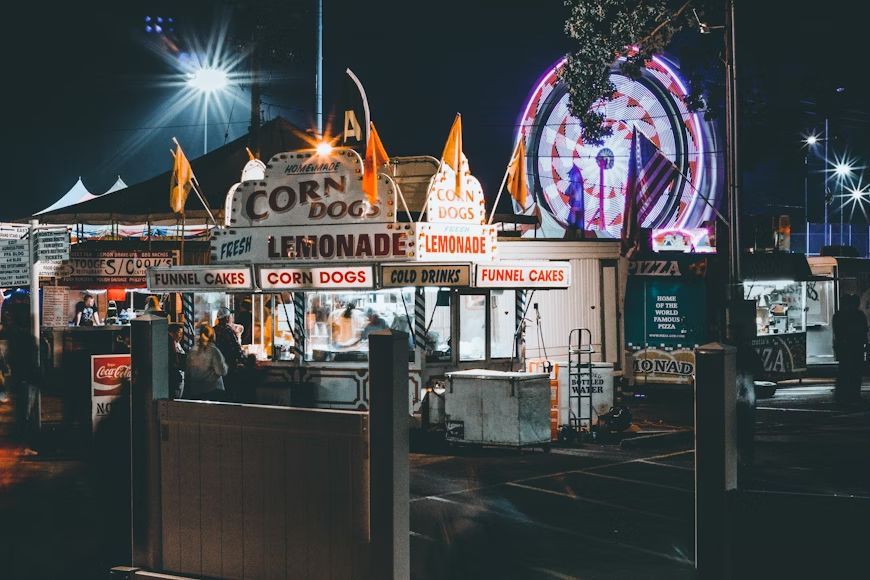
Image: Taylor

A hot dog on a stick sounds simple—we know—but getting to the modern corn dog took some trial and error. Patents were filed, batter recipes tweaked, and somewhere between a beach shack in Illinois and a fairground in Texas or Oregon, the corn dog was born. One thing’s for sure: once Americans figured out how to deep-fry a hot dog in cornmeal, there was no going back!

5
S’mores and the sweet tooth showdown

Image: Jonathan Taylor

Did you know the Girl Scouts have such a legacy? Their 1927 handbook gave us the first printed recipe for s’mores, and we’ve been hooked ever since. Roast a marshmallow, squish it between graham crackers and chocolate, and try not to eat five. Campfire memories wouldn’t be the same without this gooey, finger-sticky treat. And yes, of course—they stand for "some more."

6
The Caesar salad’s border-crossing fame

Image: Frames For Your Heart

Italian chef Caesar Cardini whipped up this leafy dish not in Rome, but in Tijuana. During the Prohibition era, Americans sneaked over the border for a legal drink and left raving about the crunchy, garlicky salad. It may have Mexican birth papers, but with Hollywood stars singing its praises and the dressing later patented in the US, the Caesar salad became a true celebrity.

7
Philly cheesesteaks: city of hoagie love

Image: Syed F Hashemi

Philadelphia's most famous sandwich started with a hot dog stand and a hunk of beef! Pat Olivieri slapped some steak on a roll, later added cheese, and boom—the cheesesteak was born, and the rest is history. Locals still argue over where to get the best one, but everyone agrees it’s a sandwich worth standing in line for.

8
Spaghetti and meatballs, made the American way

Image: Ivy Farm

If you order spaghetti and meatballs in Italy, they’ll look at you funny. Why? Because this comfort food classic was created by Italian immigrants in New York. Meat was cheaper here, sauce was plentiful, and suddenly, Sunday dinner had a new star. It’s Italian by ancestry but all-American in execution.

9
Chocolate chip cookies, thanks to a happy accident

Image: SJ 📸

Sometimes the best things happen by mistake. Here’s an example: Ruth Wakefield, owner of the Toll House Inn, wanted to make chocolate cookies but didn’t melt the chocolate—and voilà, the chocolate chip cookie was born. Nestlé acquired the recipe, and now it’s printed on every bag of chips. Homemade, store-bought, or eaten straight from the dough, this cookie is as American as it gets.

10
Jambalaya and its melting pot roots

Image: Kalyani Akella

Let’s close things out with a burst of flavor: Jambalaya may have a European passport, but it earned its American green card in Louisiana. Spanish paella, West African jollof rice, and French seasonings all came together in New Orleans, where rice, meat, and veggies came together to create one exquisite dish for everyone to enjoy!

Geography Geography 3 min read

10 American train stations that are a work of art

Image: Brady Hood

Many of America's train stations are much more than just transit hubs; they are authentic architectural marvels with distinct designs and rich histories. Built mostly in the first half of the 20th century, these spaces reflect the culture and confidence in the future of our nation. Would you like to know more? Join us as we go through 10 railway stations that make this country proud.

1
Union Station, Washington, D.C.

Image: Caleb Fisher

Washington Union Station, opened in 1907, is a fine example of Beaux-Arts architecture. Built to serve as one of the busiest transit hubs in the country, no expense was spared. The architect was inspired by ancient Roman baths. The main hall is guarded by rows of marble centurions, and the coffered ceiling is laced with gold leaf. If you want to contemplate marvellous architecture while having lunch alongside city workers and members of Congress, this is the place!

2
Penn Station, New York City

Image: c

Probably one of the world’s greatest railway stations was built in New York in 1910. And we are not talking about the famous Grand Central Terminal. The original Beaux-Arts building that was once home to Penn Station in Manhattan was an architectural masterpiece. It boasted grandiose interiors, huge waiting areas, and granite Doric columns. Unfortunately, in 1963, it was demolished to make room for Madison Square Garden, forcing the station to go underground.

3
Penn Station, Newark

Image: Pixabay

Penn Station in New York may not have survived, but a smaller-scale version still stands in Newark. New Jersey’s Neoclassical and Art Deco marvel was built in 1935 by the same architectural firm as the one in Manhattan. Featuring ornate archways, red terrazzo flooring, and green terracotta decorations, it may be less grandiose than its predecessor, but it still maintains much of its glamour.

4
30th Street Station, Philadelphia

Image: Nils Huenerfuerst

Completed in 1933, 30th Street Station in Philadelphia features a Neoclassical facade framed by 70-foot Corinthian columns. Inside, a spectacular Art Deco main concourse with a coffered ceiling adds to the station’s opulence. Fortunately, this terminal managed to preserve its former glory, and it is still in use today.

5
Main Street Station, Richmond

Image: Tangie Bodden

Main Street Station’s second Renaissance Revival architecture lights up the capital city of Virginia. Built at the turn of the century, it stands out mainly for its 110-foot brick clock tower. Past its glory days, it was neglected and suffered several damages, such as floods and fires. Fortunately, in 2003 it was restored, and today it is once again a major transit hub.

6
Birmingham Terminal Station

Image: Self-scanned, Public domain, via Wikimedia Commons

Meant to be travelers' first impression of the city, Birmingham Terminal Station once managed to astonish and amaze. Built in a Byzantine, Beaux-Arts style, it operated from 1909 to the 1950s. As automobile and air travel flourished, the station fell into disuse and was ultimately demolished in 1969 to make way for a new highway. A huge loss for the Magic City.

7
King Street Station, Seattle

Image: Zoshua Colah

King Street Station in Seattle was built at the beginning of the 20th century with a mix of architectural styles. Its main feature is a 242-foot tower modeled after the grand Campanile di San Marco in Venice. King Street Station also boasts intricate terrazzo and mosaic floors and ornamental plaster ceilings that were restored in 2010 to their former splendor.

8
Cincinnati Union Terminal

Image: Sean Foster

Cincinnati Union Terminal in Ohio is one of the boldest examples of Art Deco architecture in the United States. Its ten-story, half-domed entrance, green terrazzo, and the large rotunda decorated with industrial murals by Winold Reiss make this station a true architectural masterpiece. In fact, it is considered the greatest work of Alfred T. Fellheimer, who had previously designed Grand Central Terminal in New York City.

9
Union Station, Los Angeles

Image: Tichnor Brothers, Publisher, Public domain, via Wikimedia Commons

With a unique "Mission Moderne" style, Los Angeles’ main railroad station blends Spanish Colonial and Art Deco influences. Opened in 1939, it was built with a mix of terracotta and marble. It also features intricate tilework, beautiful courtyards, and a prominent 125-foot clock tower. Certainly a fine example of Southern California’s glamour.

10
Grand Central Terminal, New York City

Image: Robert Bye

One of the nation’s busiest stations, New York City’s Grand Central, is famous for its magnificent Beaux-Arts style. The terminal, located in Midtown Manhattan, opened in 1913. It features a signature four-faced Tiffany clock and a celestial dome above the main concourse that draws the sighs of travelers from all over the world.

Culture Culture 4 min read

Ominous Hollywood

Is your favorite on this list? 10 iconic apocalyptic movies

Image: Max Ovcharenko

Alien invasions, nuclear accidents, or major natural disasters… The end of the world has been depicted countless times in cinema. Whether for their spectacular visuals or their realistic portrayal of humanity’s demise, some of these films have become icons that most of us have likely seen and remember vividly. Join us as we explore the most popular American apocalyptic films.

1
Independence Day

Image: Jason W

Nothing beats a classic apocalyptic alien invasion, where extraterrestrials arrive to destroy the planet, but encounter a group of humans willing to give everything to save humanity. This is the premise of Independence Day (1996), one of the most famous disaster films. Starring Will Smith, the movie marked a turning point in science fiction, showcasing visual effects that, although they may not be as surprising today, set a new standard at the time.

2
Armageddon

Image: Javier Miranda

It’s hard to keep track of how many explosions light up the screen in Armageddon (1998), but rest assured, there are a lot of them. This film follows the classic natural disaster formula: a massive asteroid threatens Earth, and the only hope for survival is to destroy it. When the planet’s at risk, who better to call than Bruce Willis? Alongside Ben Affleck, he steps up to risk everything in a race against time.

Do you also remember this movie every time you hear Aerosmith's "I Don't Wanna Miss a Thing"? You are one of us!

3
The Day After Tomorrow

Image: Mason Mulcahy

A new Ice Age threatens humanity after a series of devastating storms strike the planet in The Day After Tomorrow (2004), a film that takes climate change and pushes its possible consequences to the extreme. With spectacular disaster sequences and visuals, the movie became a total box office success worldwide.

4
I Am Legend

Image: Natalya Letunova

Imagine waking up one day and realizing that you are, as far as you can tell, the last survivor in the city. This is what happens to scientist Robert Neville, played by Will Smith, in I Am Legend (2007). The now-classic apocalyptic theme is a deadly virus that has devastated humanity, and it is Dr. Robert Neville who appears to be the only one capable of doing something to reverse the effects of this.

5
Interstellar

Image: Guillaume Le Louarn

In 2014, we saw one of the most exciting movies to hit the big screen: Christopher Nolan's Interstellar . Acclaimed by audiences and critics alike for its visual effects and its complex and thrilling plot, this film is one of those you’ll find hard to forget. Set on an Earth that is becoming uninhabitable, Matthew McConaughey plays Cooper, a former NASA pilot who joins a mission to travel through a wormhole near Saturn in search of a new place for humanity.

Fun fact: It’s not surprising that it has been well received even by the scientific community, since a Nobel Prize–winning physicist collaborated on the script.

6
Planet of the Apes

Image: Mateusz Suski

In the original Planet of the Apes (1968), the story takes us to a distant future planet where chimpanzees, gorillas, and orangutans have evolved to possess human-like intelligence and social structures, dominating that world while humans are reduced to an oppressed species. Featuring one of the most shocking and unforgettable plot twists in cinema history, the film stands as an essential classic of dystopian science fiction.

7
Night of the Living Dead

Image: Daniel Jensen

We couldn’t leave Night of the Living Dead off this list, the 1968 film that changed cinema forever. While the concept of "zombies" may feel familiar today, this George A. Romero’s film was the first to present the idea of the dead rising again and becoming a real threat to the living.

8
12 Monkeys

Image: Liam Andrew

Bruce Willis is once again called upon to help humanity (or what remains of it) in the 1995 film 12 Monkeys , this time alongside none other than Brad Pitt, who earned an Oscar nomination for this role. Set in a dark future, most of humanity has been wiped out by a deadly virus, and Willis’s character must travel back in time to gather information about its origins and help find a way to stop it.

9
Dawn of the Dead

Image: airci K

Of course, George A. Romero wasn’t going to appear just once on this list. In 1978, Dawn of the Dead was released, once again portraying the end of the world brought on by the return of the undead. A group of survivors takes refuge in a shopping mall, but human conflicts soon emerge as a threat equal to, or even greater than, that posed by the zombies themselves.

10
The Day the Earth Stood Still

Image: Michael Herren

The Day the Earth Stood Still (1951) is definitely a science fiction classic. Unlike the other films on this list, its catastrophe is not inevitable; disaster can still be avoided. Rather than centering on spectacular destruction, the film delivers a philosophical warning to humanity. An alien visitor arrives on Earth to deliver a stark message: abandon nuclear violence, or face devastating consequences.

Explore more American facts

Choose your favorite category!

General
General

As American as apple pie—the very best America has to offer!

Culture
Culture

Delve into the astounding richness of American lore.

Geography
Geography

Hop in and explore vast and diverse American landscapes.

History
History

Discover the key moments that shaped the United States.