General General 6 min read

Where ingenuity and creativity meet

Behind closed doors: 12 hidden secrets of American landmarks

Image: Kenny Nguyễn

For some, architecture might seem like the most boring subject in the world, but if you take a closer look, you'll discover that sometimes buildings hide fascinating secrets. From skyscrapers and monuments to government buildings, America has iconic structures guarding incredible mysteries behind their walls. Read on to uncover the secrets hidden beneath, within, and atop 12 of the most paradigmatic structures in the U.S.

1
Gateway Arch’s time capsule

Image: Roger Miesfeld

The Gateway Arch, the 630-foot-tall monument located on the west bank of the Mississippi River in St. Louis, Missouri, is famous for being the world's tallest arch. But few people know about the secret hidden at its peak.

In 1965, before the final piece of the stainless steel arch was put in place, a time capsule containing the signatures of 762,000 St. Louis students and residents was welded into the keystone. Just one more fun fact added to the mystique of this midwestern icon!

2
A celluloid treasure trove

Image: Denise Jans

Have you ever wondered where Hollywood's golden age films are preserved? Well, as it happens, they are not in the basement of some Tinseltown studio but more than 650 feet below the surface in a facility in Hutchinson, Kansas. Established in 1959, Underground Vaults & Storage specializes in storing a wide range of valuables, including paper documents and client records.

In addition, this site is a precious resource for the entertainment industry. Underground Vaults & Storage preserves—under optimal temperature and humidity conditions—film copies of classic cartoons, television programs like Friends , game shows, soap operas, and even the original reels of cinematic masterpieces like The Wizard of Oz and Gone with the Wind .

3
A ‘Big Basket’ building
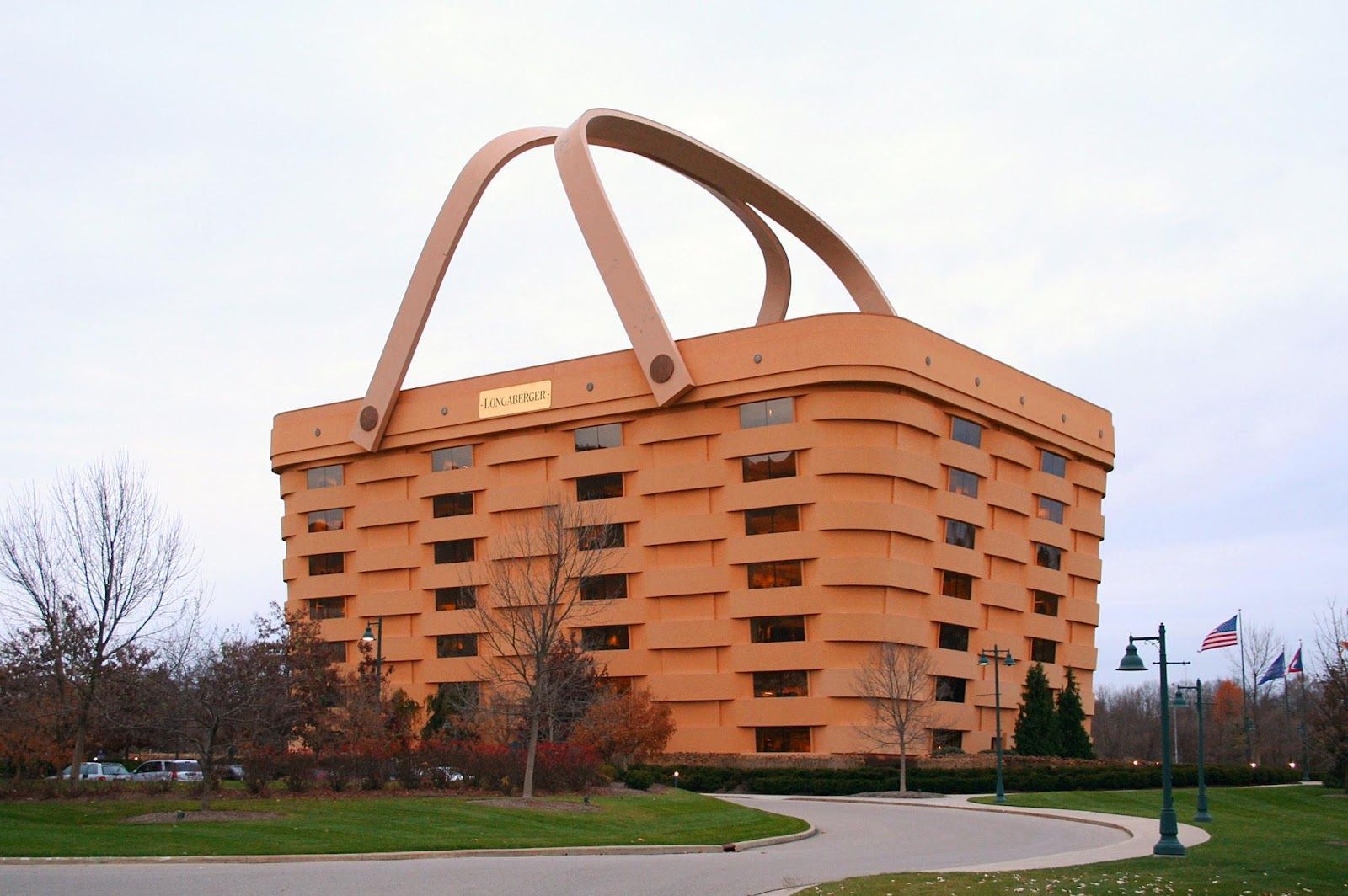
Image: Photo shot by Derek Jensen (Tysto, Public domain, via Wikimedia Commons

Who says a building has to look traditional to be iconic? Why settle for an ordinary office building when you can work inside a basket? That's what the executives of the Longaberger Company, an American manufacturer and distributor of handcrafted maple wood baskets, thought when they relocated to Newark, Ohio, in 1997.

Their headquarters was designed as a seven-story building, a perfect replica of the company's top-selling product, the Medium Market Basket. The massive handles are attached to the structure with copper and wooden rivets, and the gold-leaf-plated tags each weigh 725 pounds. Though the building was a novelty, the company eventually abandoned it, and it is now listed for sale.

4
Empire State Building Wedding Club

Image: William Wachter

Popping the question on top of the Empire State Building has become a cherished tradition in the United States. Thousands of couples travel from all over the country to get engaged at one of New York City's most iconic buildings. But did you know that you can also celebrate a wedding there?

Every February 14, a few lucky couples are granted the unique opportunity to exchange wedding vows at the building's 86th Floor Observatory. Since 1994, hundreds of couples have said "I do" at this breathtaking location, celebrating Valentine's Day at America's most romantic landmark.

5
A supernatural castle

Image: Michelle_Raponi

Creativity, ingenuity, and perseverance can achieve extraordinary feats. Such is the case with Coral Castle, a massive limestone structure built by self-taught engineer Edward Leedskalnin in the early 20th century.

Located just north of Homestead, Florida, sits this construction built with stones larger than those at Stonehenge. Leedskalnin, who invested more than 28 years in this project, claimed that he raised it single-handedly using reverse magnetism and supernatural abilities. The truth is he probably used pulleys and other tools, but that doesn’t make it any less of a unique and original building that is a fascinating tourist attraction to this day.

6
Walt Disney's utopian city

Image: Paul Moody

Walt Disney was a visionary, and thanks to his infinite imagination today we have the most endearing characters and the best amusement parks in the world. But did you know that Disney originally envisioned his famous EPCOT Center as the blueprint for a larger utopian society?

EPCOT stands for Experimental Prototype Community of Tomorrow. Had Disney’s dream come to fruition, 20,000 people could have lived in a real, futuristic city complete with residential areas, shopping malls, factories, recreational parks, and a state-of-the-art multimodal road system to connect it all. Unfortunately, after his death in 1966, the company felt his original vision was a bit impractical. Instead, they created a theme park that captures the spirit of its creator, a permanent celebration of human achievement, from culture to technological innovation.

7
Secret codes

Image: Pixabay

The CIA is a mysterious organization, so it's no wonder that there is a sculpture hiding secrets sitting right in the courtyard of the George Bush Center for Intelligence in Langley, Virginia.

Named "Kryptos," this large copper sculpture was installed in 1990 and holds a series of four encrypted messages. Only three of these codes have been cracked, while the fourth remains one of the most famous unsolved cryptograms in the world.

8
The paper house

Image: Daderot, Public domain, via Wikimedia Commons

It seems that the 1920s was a time of inventiveness, innovation, and originality in architecture. During this decade, the United States built the most impressive skyscrapers and, as we've explored, even a massive limestone castle. But a house made of paper? It seems almost impossible, doesn’t it?

Well, we are about to prove you wrong. In 1924, a mechanical engineer called Elis Fritiof Stenman built a summer cottage made almost entirely out of pasted, coated, or rolled-up newspapers. The only exceptions were the framework, floorboards, and shingles. The house is located in Rockport, Massachusetts, and, believe it or not, is still standing and can be visited.

9
Race into the sky

Image: roberto_bellasio

The Chrysler Building on the East Side of Manhattan in New York City was once the world’s tallest building, holding the title for 11 months. But did you know that it almost didn't make it? Industrial pioneer Walter Chrysler, who commissioned the project, wanted his building to be taller than the Eiffel Tower. Originally designed to be 925 feet tall , the imminent construction of other taller skyscrapers forced architect William Van Alen to revise his plans.

This competition for the title of the world’s tallest building became known as the " Race into the Sky ." To beat his opponents, Van Alen ordered a 125-foot spire to be built in secret. It would only be attached to the roof after the rival buildings were finalized. When it was finished in May 1930, the Chrysler Building reached 1,046 feet, making it the tallest man-made structure in the world at the time. Unfortunately, less than a year later, the Empire State Building would claim that honor.

10
A laboratory under the sea

Image: NEOM

Did you know the world's only undersea research laboratory is located in the United States? Sixty-six feet below the surface of the ocean off the coast of Florida lies Aquarius Reef Base, an underwater lab where researchers work for up to ten days at a time.

Aquarius is dedicated to the study and preservation of coral reefs, fish, and aquatic plants. The facility is currently operated by Florida International University and contains sophisticated state-of-the-art lab equipment.

11
Give me the time of day

Image: Leo_Visions

A bridge that tells time? We are not kidding! When it’s not being used by pedestrians and cyclists to cross the Sacramento River in Redding, California, the Sundial Bridge at Turtle Bay serves as a giant timepiece.

The bridge's 217-foot support tower points north, and its shadow can be used to calculate the time. Designed by renowned Spanish architect Santiago Calatrava, it was completed in 2004. So now you know, if your watch breaks or your cell phone dies on your way to Turtle Bay Exploration Park, you don't have to worry, the Sundial Bridge will always tell you the time of day!

12
The Capitol Subway System

Image: Harrison Haines

Few people know that a network of subway cars runs beneath Washington’s labyrinthine Congressional headquarters. The first Capitol Subway System opened on March 7, 1909, and has been transporting politicians seeking shelter from the weather—and curious onlookers—for more than a century.

The rails stretch for nearly a mile, connecting the United States Capitol to several congressional office buildings. While the public can ride the trains, the subway is restricted to congressional members and staff during votes.

Culture Culture 5 min read

MAKING HISTORY

From Mel Brooks to Viola Davis: 10 American stars who are EGOT winners

Image: Mirko Fabian

Have you ever heard of an EGOT artist? EGOT artists are a select group who've had the honor of receiving the four major entertainment awards in the United States: the Emmy, the Grammy, the Academy Awards, and the Tony Awards (hence the acronym of the name). Winning all four awards is an exceptional achievement, and only a small number of artists throughout history achieved this prestigious title. In this article, we've rounded up 10 of the most beloved American artists who reached EGOT status.

1
Richard Rodgers

Image: Dayne Topkin

Legendary composer Richard Rodgers was the first artist to achieve the EGOT. Over the course of his career, he composed 43 Broadway musicals and more than 900 songs. In addition to winning all four of the entertainment industry's top awards, Rodgers received a Pulitzer Prize, making him the first person to be awarded all five prizes.

In 1945, he won the Oscar for his song in the musical State Fair . Five years later, he received the first of his six Tonys for South Pacific (he would also win for The King and I and Pipe Dream , among others). In 1960 The Sound of Music gave Rodgers his first Grammy. Finally, in 1962, he completed the EGOT thanks to his composition for The Valiant Years , a documentary series about Winston Churchill.

2
Helen Hayes

Image: Alfred Cheney Johnston, Public domain, via Wikimedia Commons

In 1977, Helen Hayes became the first woman to earn the title of EGOT artist after winning a Grammy for Best Spoken Word Recording for Great American Documents . The famous actress, also known as "First Lady of American Theatre", received her first Academy Award in 1931 for The Sin of Madelon Claudet —in 1970, she would receive another for _Airport_—.

A few years later, she won two Tony Awards for Happy Birthday and Time Remembered , and an Emmy for the Schlitz Playhouse of Stars series. But that's not all. Hayes was such a significant artist for American culture that, in 1986, she received the Presidential Medal of Freedom and the National Medal of Arts in 1988.

3
Marvin Hamlisch

Image: Lucas Alexander

Composer Marvin Hamlisch, who gained fame and critical acclaim for a prolific career working on the soundtracks of dozens of films and plays, finally achieved his fourth distinct award in 1995. It was due to an Emmy for the music and lyrics for Barbra: The Concert.

By the mid-1970s, he had already won three Academy Awards for The Way We Were and The Sting , four Grammys, and a Tony for A Chorus Line . Did we mention that he also received a Pulitzer Prize? Certainly, Hamlisch was one of the most accomplished artists of the 20th century.

4
Mel Brooks

Image: Felipe Vieira

With a career spanning over seven decades , director, comedian, and screenwriter Mel Brooks has won multiple prizes and distinctions, including all four of the entertainment industry's top awards, a Kennedy Center Honor, a Hollywood Walk of Fame star, and a National Medal of Arts, among many others.

Brooks finally became an EGOT artist in 2001. The artist won four Emmys for Outstanding Writing Achievement in Variety and as a guest actor on the sitcom Mad About You ; three Grammys as a composer and comedian; an Academy Award for Best Original Screenplay; and three Tony Awards for the theatrical version of The Producers , the most awarded musical in the history of Broadway.

5
Whoopi Goldberg

Image: Library of Congress Life, CC0, via Wikimedia Commons

The star of The Color Purple , the beloved Whoopi Goldberg, is the first African-American to achieve EGOT status. In 1986, she received her first award, a Grammy for Best Comedy Album. In 1990, she added another accolade to her list with an Academy Award for Best Supporting Actress for Ghost .

In addition, in 2002, Goldberg won both the Tony Award as a producer of the musical Thoroughly Modern Millie and her first Daytime Emmy for Beyond Tara: The Extraordinary Life of Hattie McDaniel —in 2009, she would win another for The View .

6
Mike Nichols

Image: cottonbro studio

American film and theater director Mike Nichols, known for masterpieces such as Who's Afraid of Virginia Woolf? , Silkwood , and Working Girl, fell short of the EGOT in the 1960s. However, he finally earned the coveted title in 2001, when he received two Emmy Awards for his TV movie Wit .

In 1962, he was awarded a Grammy for his comedy show with Elaine May. Two years later, he won the first of his nine Tonys for the theatrical version of Barefoot in the Park . In 1967, Nichols received an Oscar for directing the mythical The Graduate . The Emmy had to wait 34 more years, but fortunately, it ended up arriving four years before he died in 2014.

7
Jennifer Hudson

Image: Kazuo ota

Did you know that Jennifer Hudson is the youngest woman to become EGOT? She earned the title in 2022, when she won a Tony for producing the Broadway show A Strange Loop .

Hudson already had an Oscar for Best Supporting Actress for Dreamgirls , a Grammy for her 2009 debut studio album, and a Daytime Emmy for her role as executive producer on Baby Yaga .

From rising to fame for her appearance on the third season of the reality series American Idol to being inducted into the Hollywood Walk of Fame, the 42-year-old actress and singer is one of the most promising artists of the 21st century.

8
John Legend

Image: Lijo Joseph

In 2018, singer, songwriter, and producer John Legend made history by becoming the first African American man to achieve EGOT status. In addition, Legend is the first person to receive the four awards in four consecutive years.

The artist can proudly boast 18 Grammys, including Best New Artist and Best R&B Album. In 2014, he received an Academy Award as composer of the song "Glory" for the movie Selma , while three years later, he won a Tony Award as co-producer of the revival of the classic Jitney . Lastly, in 2017, Legend gained EGOT status by winning an Emmy for Outstanding Variety Special as producer of Jesus Christ Superstar . The musical was a television special in which he also appeared as the lead actor.

9
Viola Davis

Image: Mirko Fabian

It's no secret that American actress Viola Davis is one of the most outstanding artists of her generation. Fortunately, her hard work was finally recognized when, in 2023, she received the last award she needed to join the distinguished EGOT group: the recording of her memoir Finding Me got a Grammy for Best Audio Book.

Previously, Davis had won an Oscar for Best Supporting Actress for Fences , an Emmy for Outstanding Lead Actress in a Drama Series for her role as criminal defense attorney Annalise Keating in How to Get Away with Murder , and the Tony for her performance in King Hedley II .

10
Robert Lopez

Image: Marius Masalar

"Let it Go", the popular theme song from Disney's animated movie Frozen, has been playing since 2013 and remains a commercial success to this day. That may explain why composer Robert Lopez has become the youngest person to enter the EGOT hall of fame. Moreover, he is the only one to have two of each of these awards.

In 2004, the American songwriter won a Tony Award for Avenue Q . The streak continued with two Emmys for his work in the animated musical series Wonder Pets! The Broadway show The Book of Mormon gave him his first Grammy and two new Tonys. Lopez completed the medal count in 2014 with an Academy Award for Frozen, and in 2018, he was recognized for "Remember Me" from Coco .

Culture Culture 4 min read

The king of the Western

John Wayne: 10 facts about 'The Duke'

Image: Willi Puschel

John Wayne is one of the great names of the Western genre and American Cinema in general. With a career spanning five decades and nearly 200 films, " The Duke " became an American icon and set the standard for many actors who followed. Let’s take a look at 10 facts about his life!

1
Marion

Image: Noom Peerapong

We know him as John Wayne, but he was born Marion Robert Morrison . His early minor roles were credited under the name "Duke Morrison," but he adopted a stage name for his first starring role in The Big Trail . The film’s director suggested "Anthony Wayne," after a general from the Revolutionary War, but the studio thought it sounded too Italian, so it was changed to " John Wayne ."

2
The Duke

Image: Egor Gordeev

John Wayne’s nickname came from his childhood pet terrier , Duke . The two were inseparable, so people started calling him "Little Duke." He preferred the nickname over his given name and even used it for his first film roles. The name resurfaced years later when director John Ford began calling him "Duke" again. By then, Wayne was already a popular actor, and he welcomed the old name with open arms.

3
The footballer who wasn’t

Image: Kaleb Becker

Did you know we almost had "Duke Morrison, footballer" instead of "John Wayne, actor"? After failing to get into the US Naval Academy, Wayne enrolled at the University of Southern California on a football scholarship . But an injury from a bodysurfing accident cut his athletic career short, and he eventually had to leave college.

Not all was lost, though: silent film star Tom Mix, who received football tickets in exchange for giving summer jobs to USC players, helped Wayne land a gig as an extra and prop boy.

4
The first big role and breakthrough

Image: Jason Dent

Raoul Walsh’s The Big Trail was one of the first Western superproductions of the sound era. Walsh wanted to cast an unknown actor in the leading role and chose Wayne after spotting him moving furniture around the studio.

The film was a box office failure, and Wayne spent much of the 1930s acting in low-budget Westerns. His big break came with Stagecoach , directed by the legendary John Ford, which finally put him in the spotlight.

5
Attempts to enlist

Image: Rodrigo Rodriguez

When World War II broke out, Wayne was not drafted due to his age and family situation. Despite this, he made several attempts to enlist and even tried to convince John Ford to bring him into his military unit. Ultimately, he gave up after his studio threatened him with a lawsuit for breaching his contract. It’s said that he carried the guilt of staying behind for the rest of his life.

6
John Ford

Image: Mike Fox

John Ford’s Stagecoach established John Wayne as a leading actor and began his long collaboration with the director. The two worked together on more than 20 films, many of which are considered Western classics , including Fort Apache , The Searchers , The Man Who Shot Liberty Valance , Rio Grande , and She Wore a Yellow Ribbon .

7
Awards

Image: James A. Molnar

Wayne received several nominations and awards throughout his career, both as an actor and a director. He was nominated for the Academy Award for Best Actor for Sands of Iwo Jima and for Best Picture for The Alamo , which he also directed. He finally won the Oscar for his role as Rooster Cogburn in True Grit . He was also posthumously awarded the Presidential Medal of Freedom, and the airport in Orange County, California, is named after him.

8
International popularity (or not)

Image: Vitaliy Shevchenko

Wayne’s films made him an American icon and a celebrity both in the US and abroad. Japan’s Emperor Hirohito reportedly asked to meet him during a visit to the United States, impressed by his performance in Sands of Iwo Jima , and so did Soviet leader Nikita Khrushchev.

According to some biographers, the FBI allegedly thwarted an assassination attempt ordered by Joseph Stalin, who viewed Wayne as a symbol of anti-communist ideals. While this story remains unverified, it has become part of Wayne’s larger-than-life legend.

9
Wayne vs Sinatra

Image: Dan Burton

John Wayne was known to have feuded with several celebrities due to his strong personality and political views. One of the most prominent was his disdain for Frank Sinatra , whom he believed had communist sympathies. Their animosity escalated when Wayne reportedly filed a noise complaint against Sinatra at a hotel and allegedly got into a fistfight with one of Sinatra’s bodyguards. Despite their differences, the Duke and Ol’ Blue Eyes eventually made peace years later.

10
The Duke’s death

Image: Aubrey Odom

John Wayne died of stomach cancer in 1979, a disease many have linked to his filming of The Conqueror in the Escalante Desert, Nevada, near a nuclear testing facility. It is reported that about half of the film’s cast and crew developed cancer, and nearly half of those cases were fatal.

Wayne’s family stated that he converted to Catholicism and received baptism in his final days. He reportedly requested that his grave bear the inscription " Feo, fuerte y formal " (Spanish for "ugly, strong, and dignified," in Wayne’s own words). However, his grave remained unmarked for 20 years after his death.

Explore more American facts

Choose your favorite category!

General
General

As American as apple pie—the very best America has to offer!

Culture
Culture

Delve into the astounding richness of American lore.

Geography
Geography

Hop in and explore vast and diverse American landscapes.

History
History

Discover the key moments that shaped the United States.